Ship software your customer trust. Now ship AI you can trust too.

We test the systems your business runs on, from web and mobile applications to LLMs, RAG, agents, and predictive ML, with measurable quality gates so every release reaches production with confidence.


    By ticking this box, you agree to ⋮IWConnect’s Terms & Privacy Policy. You also agree to receive future communications from ⋮IWConnect. You can unsubscribe anytime.

    One QA partner, two disciplines

    Traditional QA catches broken code. AI fails differently.

    Classic testing still matters: functionality, performance, security, integrations. But AI systems break in ways a unit test never sees. We cover both, so a model change and a code change are held to the same standard before they reach your users.

    • Hallucination & grounding checks on every output
    • Prompt injection & jailbreak red-teaming suite
    • PII leakage scanning across model outputs
    • Regression baselines so every model change is tracked
    • Latency & cost profiling under real load
    What stays hidden until it isn't

    The hidden risks in production AI

    The failures that hurt most are the ones that pass every traditional test and surface only after launch.

    Hallucination blind spots

    Confident, wrong answers that damage trust. The system sounds certain while it fabricates, and standard tests never flag it.

    Bias leakage

    Systematic unfairness that goes undetected until it becomes a legal and reputational crisis hiding in everyday output.

    Quality drift

    Performance degrades quietly over time. What worked at launch slowly breaks without warning, and nobody owns the moment it does.

    What we cover

    Comprehensive QA, for software and AI

    From established software testing to AI evaluation. Switch between the two to see how we cover each discipline.

    AI quality evaluation

    Task accuracy, response consistency, hallucination detection, adversarial robustness, and agent behavior correctness.

    Safety, risk & compliance

    Toxicity checks, bias testing, data privacy, security vulnerabilities, and governance readiness.

    Performance & reliability

    Latency, throughput, cost trade-offs, failure handling, and regression across model versions.

    Operational readiness

    Monitoring, release gates, incident response, and continuous evaluation pipelines for production AI systems.

    Why it pays off

    What disciplined QA protects

    Quality work is not a cost center. It defends the things that are expensive to win back once they are lost.

    Your reputation

    Meeting the highest standards reinforces the reliability and trust your brand is built on.

    Customer satisfaction

    Reliable, user-friendly experiences turn into satisfied customers, loyalty, and advocacy.

    Your budget

    Catching defects early in development cuts costly rework and frees up resources later.

    Speed to innovate

    Robust QA clears the path for smoother adoption and faster, more confident release cycles.

    How we work

    From first review to continuous quality

    A clear path that starts with your goals and ends with release gates and monitoring you can rely on.

    1

    Discovery

    1-2 weeks

    Define use cases, risks, and acceptance criteria, and map the architecture we are testing against.

    2

    Evaluation design

    1-2 weeks

    Build the test suite, golden dataset, scoring rubric, and baseline metrics tailored to your system.

    3

    Execution & hardening

    Ongoing

    Run tests, tune prompts, retrieval, and policies, and implement safeguards and regression coverage.

    4

    Readiness & continuous QA

    At launch & after

    Set release gates, automate evaluation, and monitor for drift once the system is live.

    Technology stack

    Tooling for software & AI QA

    One stack across both disciplines. Switch between the frameworks we use to evaluate AI systems and the platforms our teams use to test the software you ship.

    Evaluation frameworks

    Structured evaluations for LLMs, RAG pipelines, and agents using benchmark suites, LLM-as-a-judge, and automated scoring.

    Braintrust | Promptfoo | DeepEval | RAGAS

    Datasets & benchmarks

    Golden datasets, adversarial inputs, and business-focused scenarios to measure quality, regression, and robustness.

    Synthetic data | Golden sets | Label Studio

    Output validation

    Validate structure, correctness, faithfulness, and consistency with schema checks, rule-based controls, and semantic evaluation.

    Schema validation | Faithfulness | LLM-as-a-judge

    RAG & retrieval testing

    Context relevance, retrieval precision, chunking quality, citation support, and grounded response behavior.

    Context precision | Recall | Grounding

    Safety & governance

    Bias, policy compliance, privacy leakage, unsafe outputs, and prompt injection resilience across critical workflows.

    Guardrails | Policy tools | Red teaming

    Observability & continuous QA

    Traces, prompt versions, incidents, and performance metrics in dashboards that support ongoing quality improvement.

    Langfuse | LangSmith | Arize Phoenix | Monitoring

    Our Success Stories

    Resource

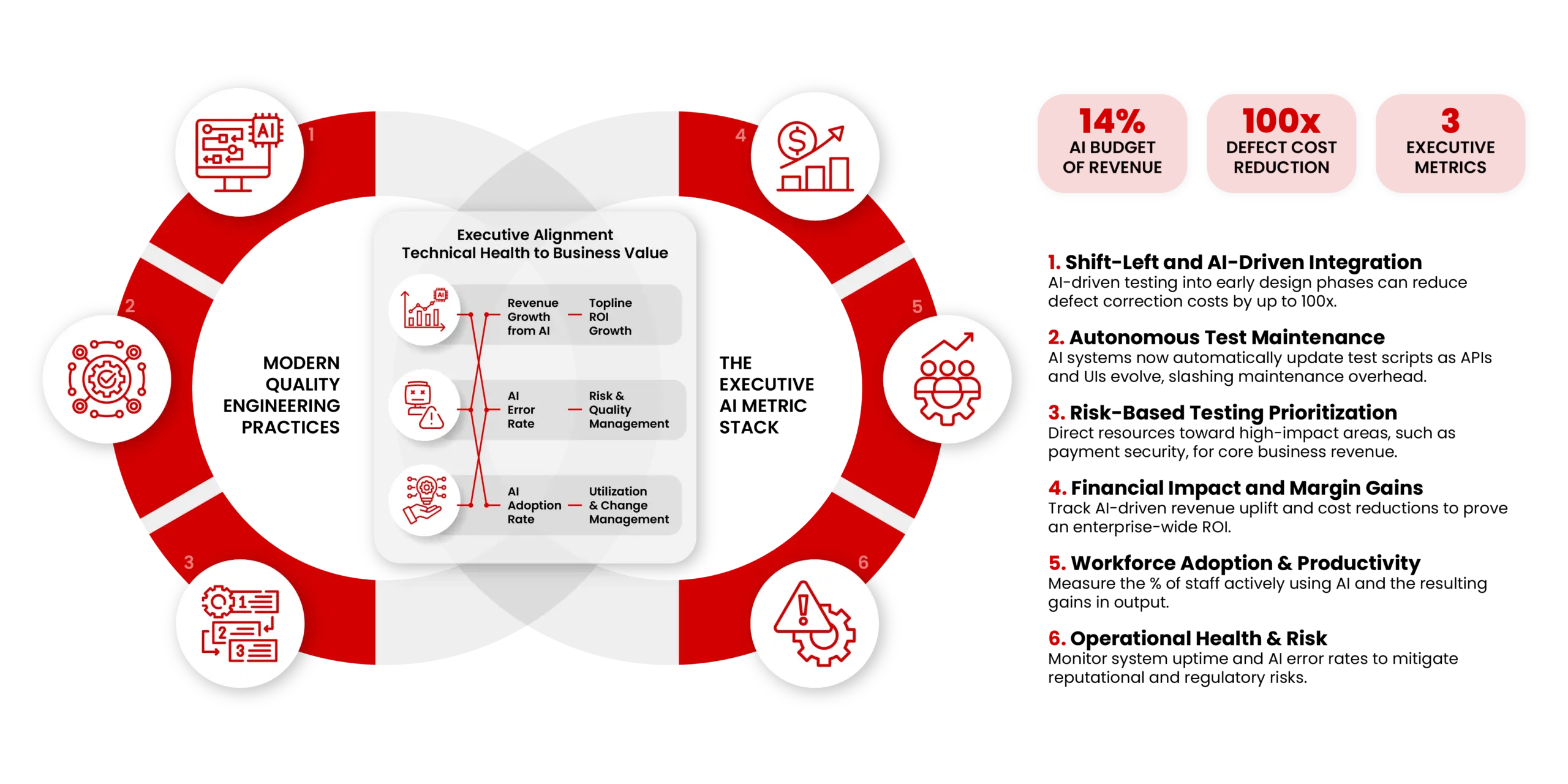
    The 2025 AI Quality & ROI Playbook: from engineering to the boardroom

    A practical guide to connecting AI quality work to business outcomes, written for the people who fund it and the people who build it.

    Get the playbook
    2025 AI Quality and ROI Playbook infographic

    QA impact on production AI

    0 %

    Hallucination detection rate

    0 %

    Reduction in production incidents
    0 X

    Faster deployment cycles with confidence

    Ready to make your AI production-ready?

    Let’s assess your current AI solution and define measurable quality gates.


      By ticking this box, you agree to ⋮IWConnect’s Terms & Privacy Policy. You also agree to receive future communications from ⋮IWConnect. You can unsubscribe anytime.

      FAQ

      Frequently asked questions

      What is AI QA?

      AI QA is the practice of evaluating and testing AI systems, including LLMs, RAG pipelines, agents, chatbots, and predictive ML, against measurable quality gates before and after they reach production. It targets the failures traditional testing misses: hallucinations, bias, prompt injection, and quality that drifts over time.

      How is testing AI systems different from testing traditional software?

      Traditional QA checks that code does what it was told to do. AI systems can fail without breaking: they hallucinate, leak bias, and degrade silently while passing every unit test. AI QA adds grounding checks, prompt-injection red-teaming, PII scanning, and regression baselines on every model change.

      What does an AI QA assessment cover?

      An assessment reviews one of your applications or AI systems to find where quality is at risk. We map the architecture, define acceptance criteria you can measure, and lay out a path to production readiness with the right release gates.

      How long does an engagement take?

      Discovery and evaluation design each run about one to two weeks. After that we move into execution and hardening, then set release gates and continuous QA that keep running after launch. Exact timing depends on the number of systems and the complexity of the use case.

      Which tools do you use?

      For AI QA we use evaluation frameworks such as Braintrust, Promptfoo, DeepEval, and RAGAS, alongside dataset, output-validation, RAG-testing, safety, and observability tooling. For software testing we work across test management, performance, security, automation, CI/CD, and test-data platforms.