Enterprise Data AI — Semantic Layer

Argus — Incident response agent

ARGUS reduces MTTR when it matters the most.

Engineers still make the final judgment call.


ARGUS collects intelligence to make sure the call is informed, fast, and consistent – whether it’s 2pm or 2am.


It’s the best way to improve your UpTime and reduce your MTTR.

  • ARGUS does not replace your monitoring tools — it makes them much more valuable and useful.
  • ARGUS sits on top — when permitted it reads from your tools, correlates, and gives your team a head start.
  • ARGUS never gets direct system access for control — it’s the tool that generates intelligence from your raw data.

    By ticking this box, you agree to ⋮IWConnect’s Terms & Privacy Policy. You also agree to receive future communications from ⋮IWConnect. You can unsubscribe anytime.

    Enterprise Data AI — Semantic Layer

    44x Faster than manual investigation AI vs. 30min manual baseline
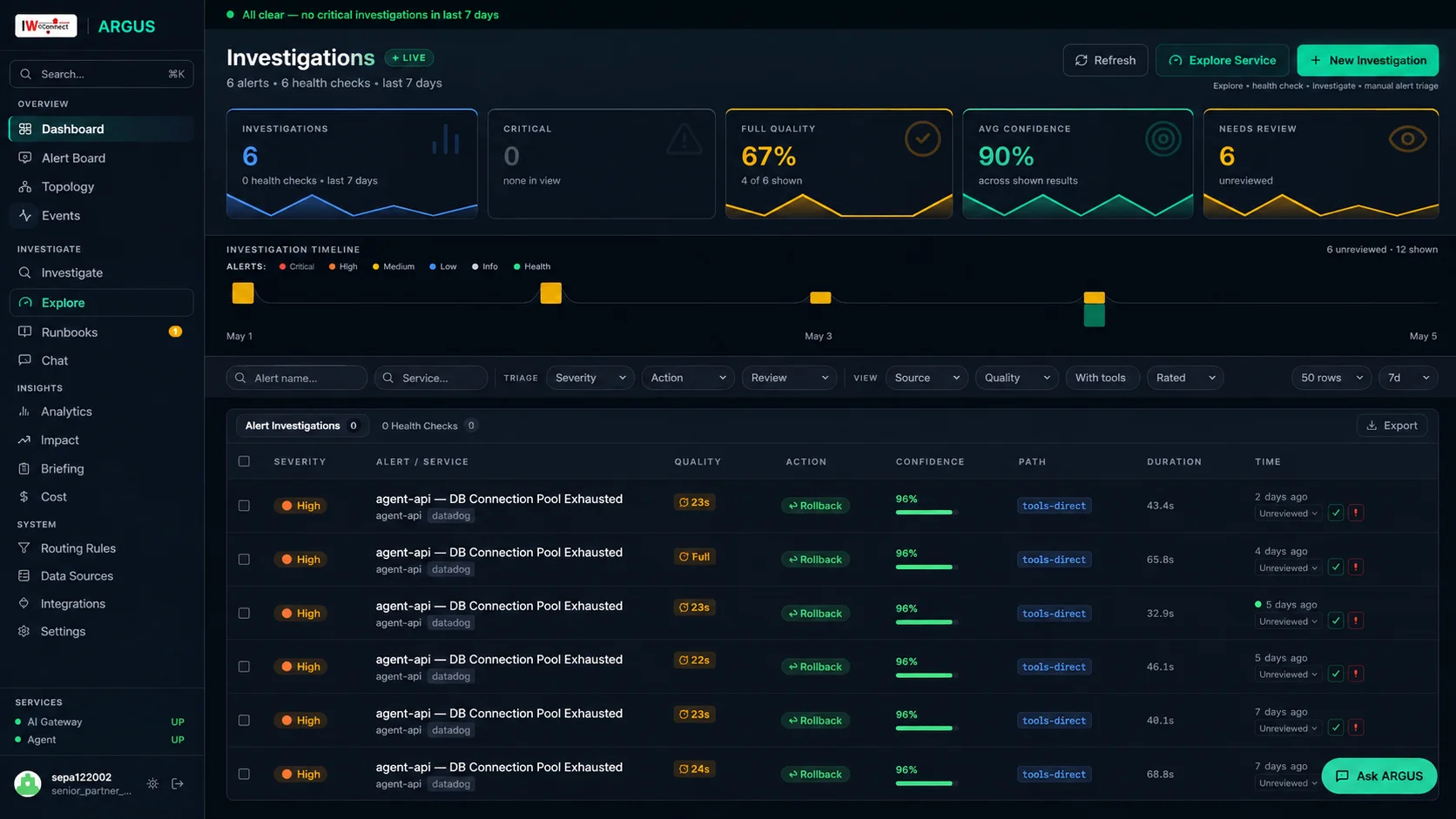
    41s Avg time from alert to root cause Across 40 automated investigations
    83% Actionable rate at ≥70% confidence 33 of 40 investigations
    63% Recurring patterns caught from history 25 chronic incidents recognised
    40–70% Reduction in overall diagnosis time MTTR improvement across deployments
    how argus works

    One agent. Every tool. One clear answer.

    Argus reads from your monitoring, deployment, logging, and topology tools simultaneously — correlates the signals, and delivers a single structured briefing your team can act on immediately.

    Investigation Intelligence

    Ranked hypotheses with numbered evidence

    Every investigation returns ranked hypotheses at confidence levels, backed by numbered evidence chains. Not a wall of logs – a structured argument your engineer can act on or challenge immediately.

    Multi-Tool Execution + Notifications

    Calls every tool, notifies every channel — automatically

    Datadog and GitHub called simultaneously. Root cause identified. Notifications fired to Slack, Jira, Teams, and ServiceNow — all in a single investigation flow. Your team is briefed before they open a laptop.

    The 2 AM Problem — Solved

    Your on-call engineer gets a briefing, not a mystery.

    The On-Call Briefing synthesises investigation history, recurring patterns, and deploy activity into one screen. Shift handover goes from a 30-minute verbal to a 5-minute review. Every time.

    38s Avg investigation time per incident
    0 Unknown root causes in last 7 days
    10x Recurring pattern detected and flagged
    Measurable Results

    The greater UpTime (MTTR) impact matters to the business.

    This isn’t a benchmark. These are the before-and-after numbers from real operations teams who deployed Argus into their incident workflows.

    Scenario Today With Argus
    Time to first hypothesis 20–45 min ~2 min
    NOC escalation decision Gut feel or wait Topology + impact in 90s
    Deployment correlation Manual GitHub / Jenkins Automatic, every investigation
    Recurring issue recognition “I think this happened before...” Structured history with root cause
    Shift handover catch-up 20–30 min 5 min investigation log review
    Cross-service impact Multi-tool navigation Blast radius on topology, instant

    Average MTTR improvement: 40–70% reduction in diagnosis time. Shift handover and NOC escalation accuracy gains alone justify the deployment.

    Built for Real Operations

    Four scenarios where Argus changes the outcome.

    This isn’t a benchmark. These are the before-and-after numbers from real operations teams who deployed Argus into their incident workflows.

    Scenario 01

    NOC Escalation Decision

    Know immediately if an alert is a blip or a P0 incident — before you wake anyone up.

    Today

    Multiple dashboards, gut feel, waiting for pattern recognition.

    With Argus

    Service topology + blast radius + deployment correlation in 90 seconds.

    Scenario 02

    Cross-Tool Error Investigation

    One question instead of five dashboards. One answer instead of five context switches.

    Today

    Datadog → GitHub → Jaeger → Slack → manual correlation. 40+ minutes.

    With Argus

    All tools queried simultaneously. Ranked hypothesis with evidence in 41 seconds.

    Scenario 03

    The 2 AM On-Call Briefing

    Direction in 90 seconds instead of 45 minutes of log archaeology.

    Today

    Engineer wakes up. Opens 6 tabs. Pieces together context from scratch. 45 minutes lost.

    With Argus

    Briefing is pre-generated. Root cause, blast radius, suggested action — ready before the call starts.

    Scenario 04

    Shift Handover Catch-Up

    Full overnight context in 5 minutes, not 30. Every shift, every time.

    Today

    20–30 minute verbal handover. Important context missed. Recurring issues not flagged.

    With Argus

    5-minute investigation log review. Recurring patterns highlighted. Nothing falls through.

    Efficiency & Cost

    27 minutes of AI work. 20 hours of manual effort saved.

    In one 30-day period: 40 investigations automated, 27 minutes of total AI processing time, equivalent to 20 hours of manual engineer time. Efficiency ratio: 44×.

    And the cost of running those 40 investigations? $0.0105 per investigation. Full cost transparency, built into the platform — AI gateway spend tracked by virtual key, per agent, per day.

    $0.0105 per investigation
    Works with Your Existing Stack

    No rip-and-replace. Connects to what you already run.

    Argus sits on top of your existing tools. It reads, correlates, and surfaces intelligence – it never replaces the systems your team depends on.

    Monitoring
    • Datadog
    • Grafana
    • Prometheus
    • Elastic
    Deployments
    • GitHub
    • Jenkins
    • GitLab
    • ArgoCD
    Logging & Tracing
    • Elastic / ELK
    • Jaeger
    • Splunk
    • Loki
    Incident & Notifications
    • ServiceNow
    • Jira
    • Slack
    • Microsoft Teams

    Why Argus?

    Argus Panoptes was the all-seeing giant of Greek mythology — 100 eyes, never sleeping, never missing a thing. Appointed to watch over what mattered most, he saw everything simultaneously, at all times. We named our incident response agent after him because that’s exactly what your infrastructure deserves: something that watches your entire stack, all the time, and never looks away — so that when something breaks at 2am, the answer is already waiting for your engineer.

    Bring us one of your incidents.
    We'll run it live.

    We start by mapping your incident workflow, service topology, and monitoring stack. Then we show you exactly where Argus cuts diagnosis time and improves escalation accuracy. No commitment required.

      By ticking this box, you agree to ⋮IWConnect’s Terms & Privacy Policy. You also agree to receive future communications from ⋮IWConnect. You can unsubscribe anytime.