Connect AI, APIs, agents and enterprise systems securely.

Build the integration layer that lets LLMs and AI agents read, reason and act across SAP, Salesforce, Workday, ServiceNow, databases, APIs, documents and custom applications — with enterprise-grade governance, observability and control.


    By ticking this box, you agree to ⋮IWConnect’s Terms & Privacy Policy. You also agree to receive future communications from ⋮IWConnect. You can unsubscribe anytime.

    API-first

    Expose governed business capabilities for AI

    Agent-ready

    Enable secure tool execution through MCP

    Observable

    Trace prompts, APIs, pipelines and casts

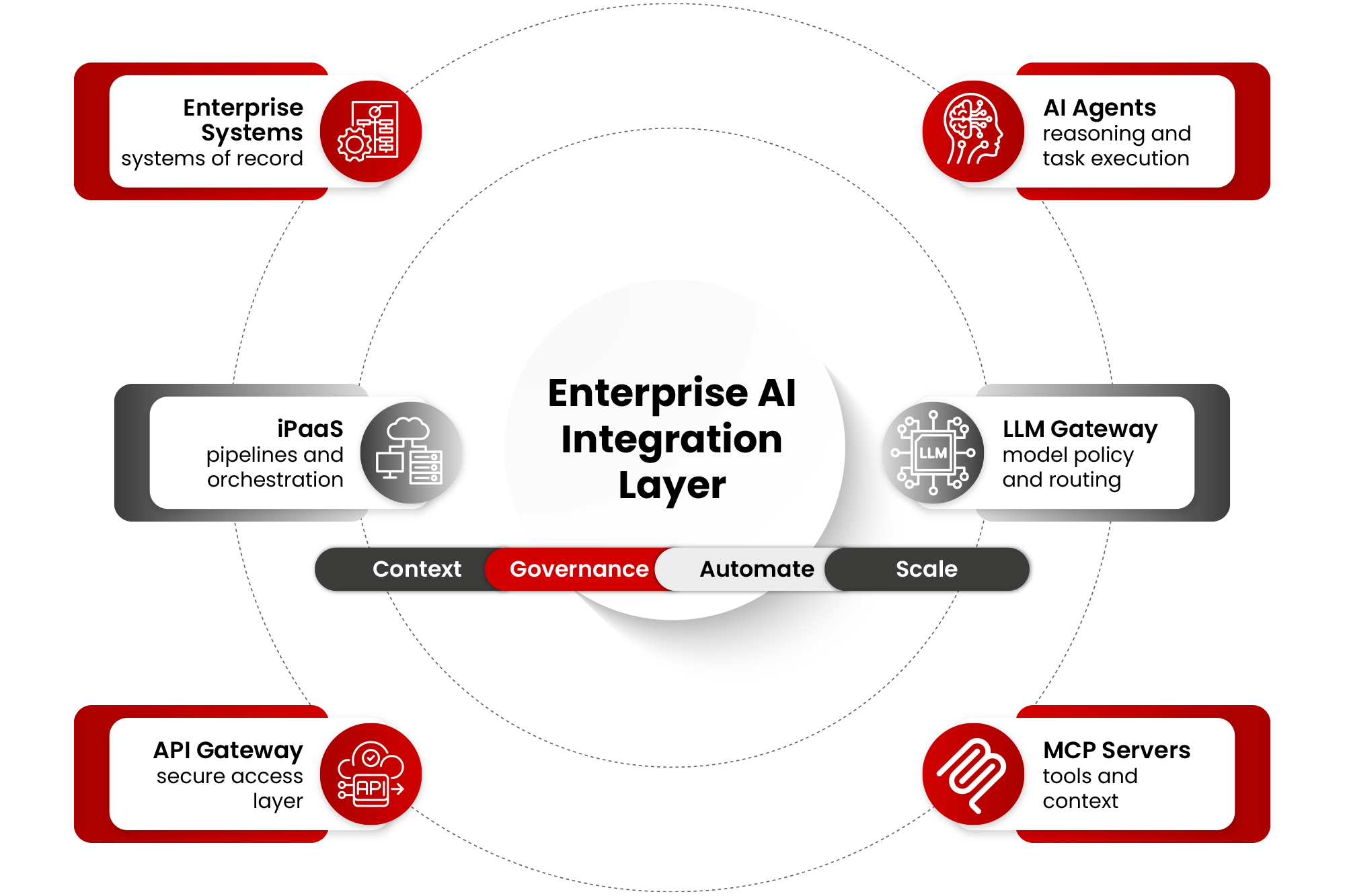
    Reference architecture for production-ready AI integration

    A modern enterprise AI integration stack isn’t a single platform — it’s eight co-operating layers, each with distinct concerns. IWConnect designs, builds, and manages all of them.

    External consumers

    Web apps, mobile clients, B2B partners, IoT devices, 3rd-party SaaS — any surface that needs AI-powered data or actions.

    REST | GraphQL | WebSocket | EDI | MQTT

    AI-enhanced API gateway

    Unified entry point with AI-aware traffic routing, OAuth 2.0 / mTLS auth, dynamic rate limiting, threat detection, and a self-serve developer portal.

    Kong | AWS API GW | Azure | APIM | Rate limiting | Developer portal

    LLM gateway

    Centralised LLM access layer enforcing model routing policies, token budgets per team, PII redaction before prompts leave the firewall, and every call logged for audit.

    REST | GraphQL | WebSocket | EDI | MQTT

    MCP tool registry

    Model Context Protocol server exposing versioned, permissioned tool definitions for SAP, Salesforce, Workday — so AI agents can discover and invoke enterprise capabilities safely.

    MCP server | Tool versioning | Permission scopes | Agent discovery

    Agentic orchestration

    Multi-agent workflows that span multiple enterprise systems end-to-end, with RAG for live context, event-driven triggers, and human-in-the-loop escalation for edge cases.

    Multi-agent | RAG pipelines | Event-driven | Human-in-loop

    Integration platform (iPaaS + AI)

    AI-enhanced data pipelines, self-healing connectors that detect schema drift, AI-assisted mapping, and event streaming via Kafka. SnapLogic, MuleSoft, Azure Logic Apps, and custom.

    SnapLogic | MuleSoft | Boomi | Azure Logic Apps | Kafka | LangfuseSelf-healing

    AI observability & governance

    End-to-end LLM call tracing, per-team cost attribution, drift and quality scoring on model outputs, policy engine for data classification, and compliance-ready audit exports.

    LLM tracingCost dashboardsDrift alertsAudit logsPolicy engine

    Enterprise systems of record

    The authoritative data sources and action targets: ERP, CRM, HCM, ITSM, data warehouses, mainframes, and bespoke legacy platforms.

    SAP | Salesforce | Workday | ServiceNow | Oracle | Legacy ERP

    Core capabilities

    Design and implement a secure AI integration backbone using SnapLogic, APIs, gateways, MCP, custom services and reusable enterprise patterns.

    AI-enhanced integration pipelines

    Add classification, summarization, enrichment, routing, exception handling and intelligent transformation into SnapLogic or custom integration workflows.

    API management for AI agents

    Expose enterprise capabilities through secured APIs so AI agents can act through governed interfaces instead of direct backend access.

    LLM and AI gateway

    Centralize model access, apply AI traffic policies, monitor prompts and responses, route models, reduce costs and enforce data protection controls.

    MCP server development

    Create standardized tool and context access for AI clients using Model Context Protocol, backed by enterprise authentication, authorization and auditability.

    RAG and knowledge integration

    Connect documents, policies, contracts, tickets and operational knowledge to LLMs using ingestion pipelines, vector search, metadata and retrieval governance.

    Governance and observability

    Trace decisions across prompts, models, APIs, pipelines and backend systems with logs, dashboards, cost controls, approvals and compliance evidence.

    LLM Gateway and API Gateway

    Control how AI talks to models, APIs and enterprise systems.

    Enterprises need a policy layer between AI applications, model providers, APIs and backend systems. This layer protects data, standardizes access, manages spend and gives teams visibility into every AI-powered transaction.


    • What to expose through MCP
    • Approved tools such as create case, check invoice, fetch order, trigger reconciliation or update CRM activity.
    • Context resources such as customer profile, contract terms, shipment status, policy documents and product data.
    • Reusable prompt templates for support, finance, HR, IT operations, compliance and development workflows.
    • Controlled workflow triggers for SnapLogic pipelines, APIs, scripts, data retrieval and document automation.

    User od AI Agent

    intent

    LLM Gateway

    policy, routing, logging

    API Gateway

    security, quota, validation

    Integration Pipeline

    orchestration, mapping, retries

    Enterprise System

    ERP, CRM, HCM, ITSM, DB

    Observability Layer

    audit, cost, traceability

    MCP for enterprise tool and context integration

    Model Context Protocol can become the standardized interface between AI clients, enterprise tools, data resources and approved prompts.

    What to expose through MCP

    • Approved tools such as create case, check invoice, fetch order, trigger reconciliation or update CRM activity.
    • Context resources such as customer profile, contract terms, shipment status, policy documents and product data.
    • Reusable prompt templates for support, finance, HR, IT operations, compliance and development workflows.
    • Controlled workflow triggers for SnapLogic pipelines, APIs, scripts, data retrieval and document automation.

    How to govern MCP

    • Use allowlisted tools and scoped permissions, never unrestricted backend access.
    • Validate all tool inputs and outputs before execution or system update.
    • Apply human approval for high-impact actions such as payments, refunds, account changes and compliance decisions.
    • Log every tool invocation with user, agent, input, output, target system and business outcome.

    Enterprise AI integration patterns

    Choose the right implementation pattern based on risk, data sensitivity, latency, action type and business process complexity.

    AI inside pipeline

    Source system → integration pipeline → AI enrichment → validation → target system. Ideal for classification, summarization and transformation.

    Agent through governed APIs

    User → AI agent → LLM gateway → API gateway → backend system. Ideal for assistants that need to execute business actions safely.

    MCP-based tool access

    AI client → MCP server → approved tool/API/pipeline → enterprise system. Ideal for reusable agent-to-tool connectivity.

    RAG with enterprise knowledge

    Documents and data → indexing → vector search → LLM → governed answer or workflow action. Ideal for knowledge-heavy processes.

    Human-in-the-loop workflow

    AI recommendation → business approval → pipeline execution → audit log. Ideal for regulated or high-risk decisions.

    Event-driven AI automation

    Business event → message queue → AI decisioning → API or workflow action. Ideal for near-real-time operational scenarios.

    Implementation methodology

    A structured approach that moves from discovery to architecture, delivery, testing, governance and scale.

    Use case discovery

    Identify where AI can assist, decide, summarize, classify, recommend or automate business processes.

    Systems mapping

    Inventory applications, APIs, data sources, owners, sensitivity, integration points and operational constraints.

    Architecture design

    Define pipelines, APIs, gateways, MCP servers, RAG services, event flows and target operating model.

    Security design

    Specify access control, masking, approval flows, audit logging, prompt safety, tool scopes and compliance controls.

    Build and configure

    Develop integrations, APIs, prompts, MCP tools, model policies, dashboards, CI/CD and environment promotion.

    Validate and test

    Run functional, integration, performance, security, prompt-injection, fallback and AI output validation tests.

    Deploy and operate

    Release safely, monitor usage, manage incidents, track costs, measure outcomes and optimize continuously.

    Scale and reuse

    Create reusable connectors, API products, prompt libraries, MCP tools, reference architectures and playbooks.

    Use cases by business domain

    AI integration should be tied to business workflows where systems, documents, decisions and actions intersect.

    Finance

    • Invoice classification and ERP posting
    • Payment exception analysis
    • Contract and purchase order matching
    • Audit evidence generation

    Customer Service

    • AI-assisted case routing
    • Sentiment and priority detection
    • Knowledge-based response generation
    • CRM update automation

    HR

    • Employee request triage
    • Workday workflow integration
    • Policy Q&A with RAG
    • Onboarding automation

    Supply Chain

    • Supplier risk analysis
    • Shipment exception handling
    • Order status automation
    • Compliance workflow support

    IT Operations

    • Incident classification
    • Runbook execution support
    • ServiceNow updates
    • Log and change summarization

    Sales and CRM

    • Lead enrichment
    • Opportunity summarization
    • Quote generation support
    • Customer intelligence aggregation

    Secure AI integration by design

    Prompt

    injection

    Use input filtering, instruction separation, tool allowlists, output validation and adversarial testing.

    Sensitive

    data leakage

    Apply data classification, redaction, tokenization, PII masking and model usage policies.

    Excessive

    agency

    Limit autonomous actions, require approvals and use scoped permissions for each tool and API.

    Insecure

    tool access

    Protect tools with authentication, authorization, parameter validation, sandboxing and audit logs.

    Cost

    overrun

    Set budgets, quotas, model routing rules, token monitoring, caching and department-level reporting.

    Compliance

    gaps

    Maintain prompt versions, model policies, trace IDs, retention rules, approvals and evidence reports.

    Documentation that writes itself

    Pete auto-generates Confluence documentation for your SnapLogic projects. From click to comprehensive docs in under a minute, no more manual documentation bottlenecks.

    Easy Export & Documentation: Instantly generate detailed SnapLogic project documentation, including dependency diagrams, in PNG, CSV, and PDF formats with predefined retention periods.

    Automated Compliance: Integrate Pete into your CI/CD workflows to automate documentation, versioning, and retention, closing compliance gaps.

    Security at Every Step: Pete’s AI-powered code review checks 27+ metrics for code quality, maintainability, and security, reducing risks.

    Streamlined Auditing: Automatically track project elements, like accounts and tasks, and access audit-ready reports with ease.

    0 %

    Reduction in documentation time

    0 x

    Faster pipeline development

    Zero

    Manual handoffs in automated flows

    0 +

    Enterprise connectors available