

Home » Data Analytics & BI
We build the governed data foundation underneath your reports. Then we turn it into dashboards, forecasts, and self-serve analytics your teams act on, without second-guessing the numbers.
Most enterprises don't have a data shortage. They have three reports that answer the same question three different ways, and no one sure which one to take to the board. Three things keep that going.
The same metric lives in five systems with five definitions. Finance, sales, and ops each bring their own number to the meeting.
When data quality is unproven, people quietly rebuild the numbers in spreadsheets, and the dashboard becomes a thing to double-check, not a thing to act on.
Teams stall while someone reconciles figures by hand. By the time the report is ready, the moment to act on it has often passed.
The cost compounds every quarter. The longer the foundation stays fragmented, the more hours go into reconciling numbers instead of using them, and the slower every decision and every launch becomes.
Data analytics and BI turns scattered, inconsistent data into one governed source of truth, then into dashboards and forecasts your teams act on. It covers the foundation, the governance, and the reporting layer as one job.
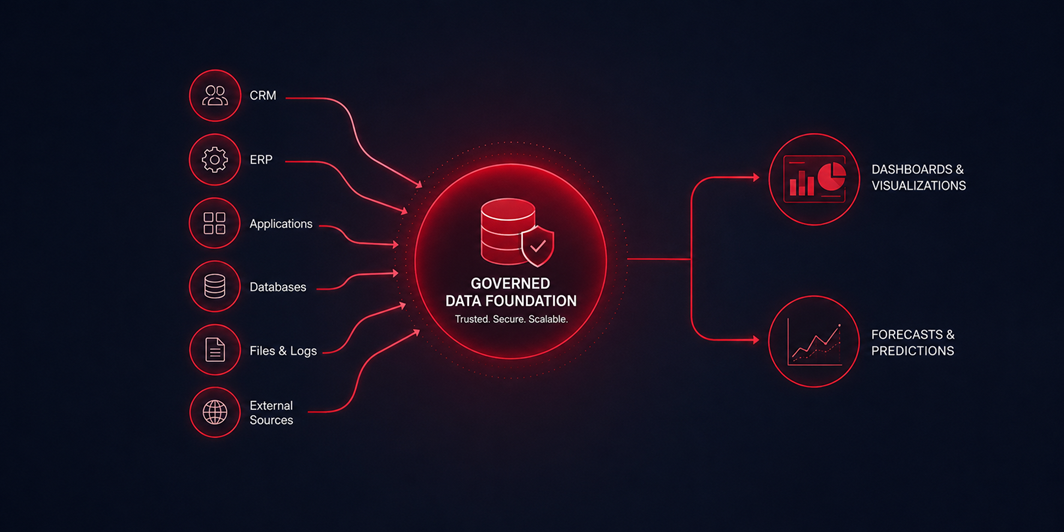
Each one is a problem we fix, not a feature we ship. Together they take you from scattered data to decisions the whole business shares.
We bring every source into one place. Reporting stops depending on whoever exported the spreadsheet last.
One agreed definition per metric, with access control and quality checks. The number in the boardroom matches the system it came from.
Reports your teams open and act on, built in Power BI or Tableau, without filing a ticket every time a question changes.
Forecasts of demand, risk, and churn from your own history, so planning runs on patterns in the data, not gut feel.
Pipelines that move and clean data on a schedule, so the morning report is already correct before anyone opens it.
Governed, well-documented data is what AI needs to work. Get this right and AI projects start from a clean base instead of a cleanup.
A data analytics and BI project usually runs in four stages: assess, build the foundation, deliver the reporting layer, then hand it over. We start small. We prove value on one real decision before we touch the whole estate, so you see a working result early rather than waiting on a year-long program.
We map your sources, find where the numbers disagree, and pick one decision worth fixing first.
We bring the relevant sources into one governed place, with quality checks and one agreed definition per metric.
We build the dashboards, self-serve views, or forecasts your teams asked for, on top of the trusted base.
Your team owns it. We document everything and stay on for support only as long as you want us there.
A global manufacturer kept acquiring companies faster than it could absorb their data. We unified the post-merger estate on a governed Snowflake foundation. Each new acquisition now plugs into one trusted source, on a base that is ready for AI.
Read the case study

We pick the tool that fits your stack and your team, not our preference. These are the data and BI platforms our engineers work in every day.
Field notes from the engineers who build these foundations, on the real problems they solve along the way.
Tell us the number your teams keep arguing about. We will show you how to get to one version of it that the whole business can act on.
Most data analytics and BI engagements show a usable result on the first decision within a few weeks, because we scope one real report before touching the whole estate. The full foundation takes longer, but you do not wait on the whole program to see value.
No. We build on the platforms you already run, whether that is Snowflake, Databricks, Power BI, or Tableau. The goal is one trusted source feeding the tools your teams know, not a rip-and-replace project.
Your team does. We document the pipelines, the metric definitions, and the dashboards, then hand over ownership. We stay on for support only for as long as you want us there, not by default.
Integration connects your systems so they share data. Data analytics and BI turns that shared data into trusted reports and forecasts. They are two halves of one foundation. See our Integration Solutions if connecting systems is the first problem to solve.
Yes, and it is the part most teams skip. AI works on governed, well-documented data. A clean BI foundation is the same base AI needs. For the AI-specific step, see Data Readiness for AI.
You keep the foundation and the documentation either way, so the work is not wasted. We scope the first phase small on purpose, so the cost of finding out is low and the decision to continue is yours.
✕
By signing up for the waiting list now, you'll secure your spot for early access and claim these valuable benefits.