AI Decision Assurance by IWConnect

Wrong answers stop here.

Every reading an AI makes gets graded by a panel of other models before anything happens with it. What passes moves on. What does not waits for a person.


Live on our own lead generation. Up to 100 records a day, none of them unscored.


Book a 45-minute call

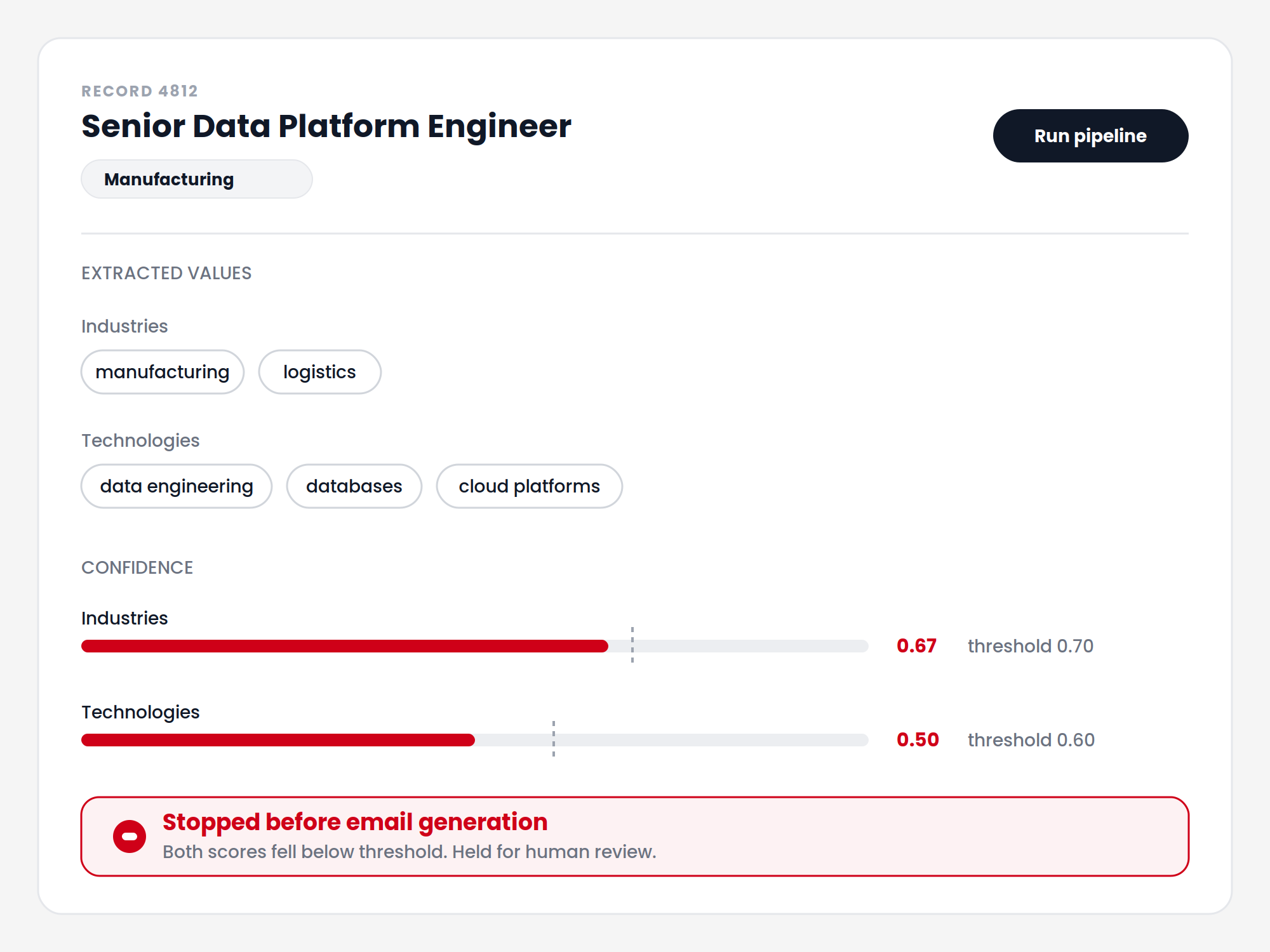
A queue of processed records, some marked as passed and some held back with a low confidence score
The problem

The model sounds the same whether it is right or wrong.

Give a language model a document and it will return an answer in seconds. It will also be wrong occasionally, and the wrong answers arrive with exactly the same confidence as the correct ones.


That is why most of these systems never leave the pilot. There is no way to tell, at the moment the decision is made, which one you are looking at. So a person checks all of it, and the automation saves nothing.


Meanwhile every call is metered. The cost grows with volume while the value is still waiting for someone to trust it.

Two model outputs side by side, one correct and one wrong, presented identically
What we build

Three layers, not one model.

The first two are live inside IWConnect today. The third is in progress.

The application layer does the work

It reads the incoming document, pulls out the values your process needs, finds what in your own material relates to them, and produces the output.

The quality layer decides whether to trust it

A panel of models scores every reading against the same standard and returns one number per value. You set the pass mark. Above it the process continues. Below it the process stops, before anything is generated, sent or recorded.

The learning layer takes the cost out

Every reading that scores perfectly is kept as a verified example. Those examples train a specialised model for that task, which runs with no charge per document once it is good enough to take over.

How it works

Four steps, one loop.

The same four moves run on every document, before and after the handover.

1

Read

The model pulls the values the process needs out of the document. One document can carry several at once.

2

Score

A panel of models grades that reading. One number per value, not an opinion.

3

Act or stop

Above the threshold the process continues. Below it, it stops. Perfect scores are kept as verified examples.

4

Hand over

The verified examples train a specialised model. It runs alongside the general one on live traffic until it scores better, then it takes the same position in the flow.

Nothing structural changes at the handover, and the scoring does not switch off, so the verified set keeps growing.

What changes, and when

Running in weeks, trusted in months, cheaper after that.

Three things arrive in order. The first is why you can start. The second is why you can deploy. The third is why you stay.

Weeks

It runs

No training data, no labelling project, no model to build first. A general model does the job from day one, which is how the internal system went live.

Months

You can deploy it

Every decision carries a score and the reasoning behind it, and the weak ones never reach anyone. That is the difference between a pilot and something in front of a customer.

After that

It costs less

The specialised model takes over the same task with no per-document charge. The bill stops tracking your volume.

Fit: the same decision made thousands of times a month, with a right answer to check against. Not a fit for open-ended writing, or for a few hundred documents a month.

Use case: built and running

From a job post nobody wrote for us, to an email with the right proof attached.

Our sales team needs to know which companies are about to spend on the work we do. A company hiring three integration engineers is one of them, and it says so publicly, in free text, in no particular format.

In The system reads each post, pulls out the industries and technologies it mentions, and scores its own reading. Industries and technologies are scored separately, so a post the system half understood is caught rather than passed on whole. Every record links back to the original, so anyone can compare what the system saw with what was there.
Out Posts that clear the line are matched against our own case studies on industry, on technology and on meaning, and the system drafts an email linking the ones that fit. Posts that fall below the line never reach this step, so nobody sends a confident pitch backed by the wrong case study.

The draft lands in the CRM. A person reads it and sends it.

Up to 100 posts a day, every day
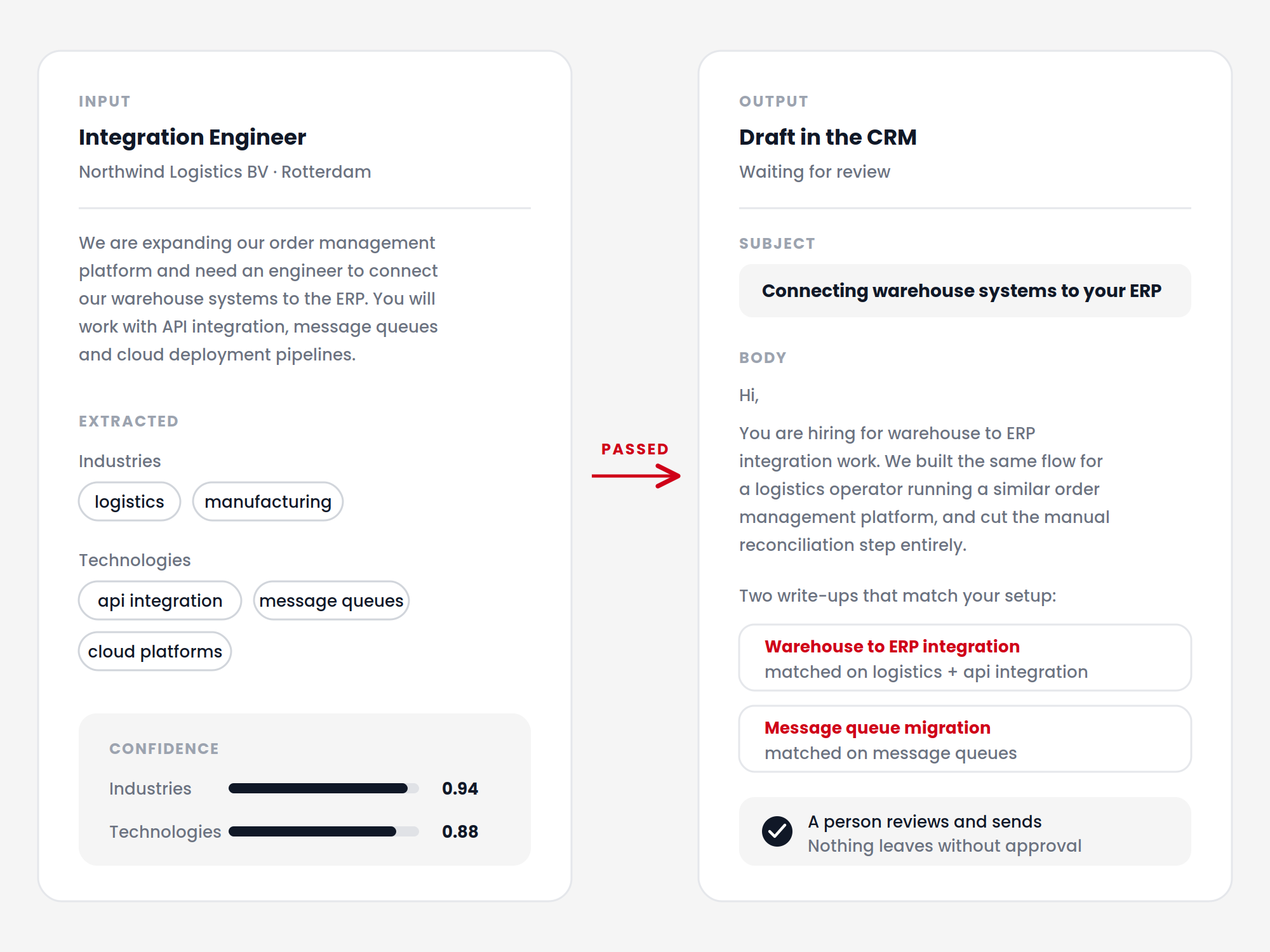
A job post with its extracted industry and technology tags beside the drafted email and its case study links
Where else it fits

Same loop, different input.

The system was built for one process and does not depend on it. If a person is reading and deciding, this fits.

Support

The lead who reads every ticket and decides which team owns it.

Operations

The team sorting inbound documents by type before anything can be processed.

Catalogue

The team tagging products at a volume nobody can review by hand.

Compliance

The officer who confirms a flag before it goes on the record, and needs the confident-but-wrong ones stopped first.

Where we are

What is running, and what is not.

The system runs inside IWConnect on our own lead generation.

100 records read and scored per day
2,000 verified examples added per month
2+ models scoring every decision
1 retraining cycle every week

The specialised models are still training. They have not yet beaten the general model, so that handover has not happened and the cost saving is a direction rather than a result. We will show you the live comparison on the call.

The scoring and the gate are live now. Those are the parts that make it deployable.

Security and governance

Built to survive an audit.

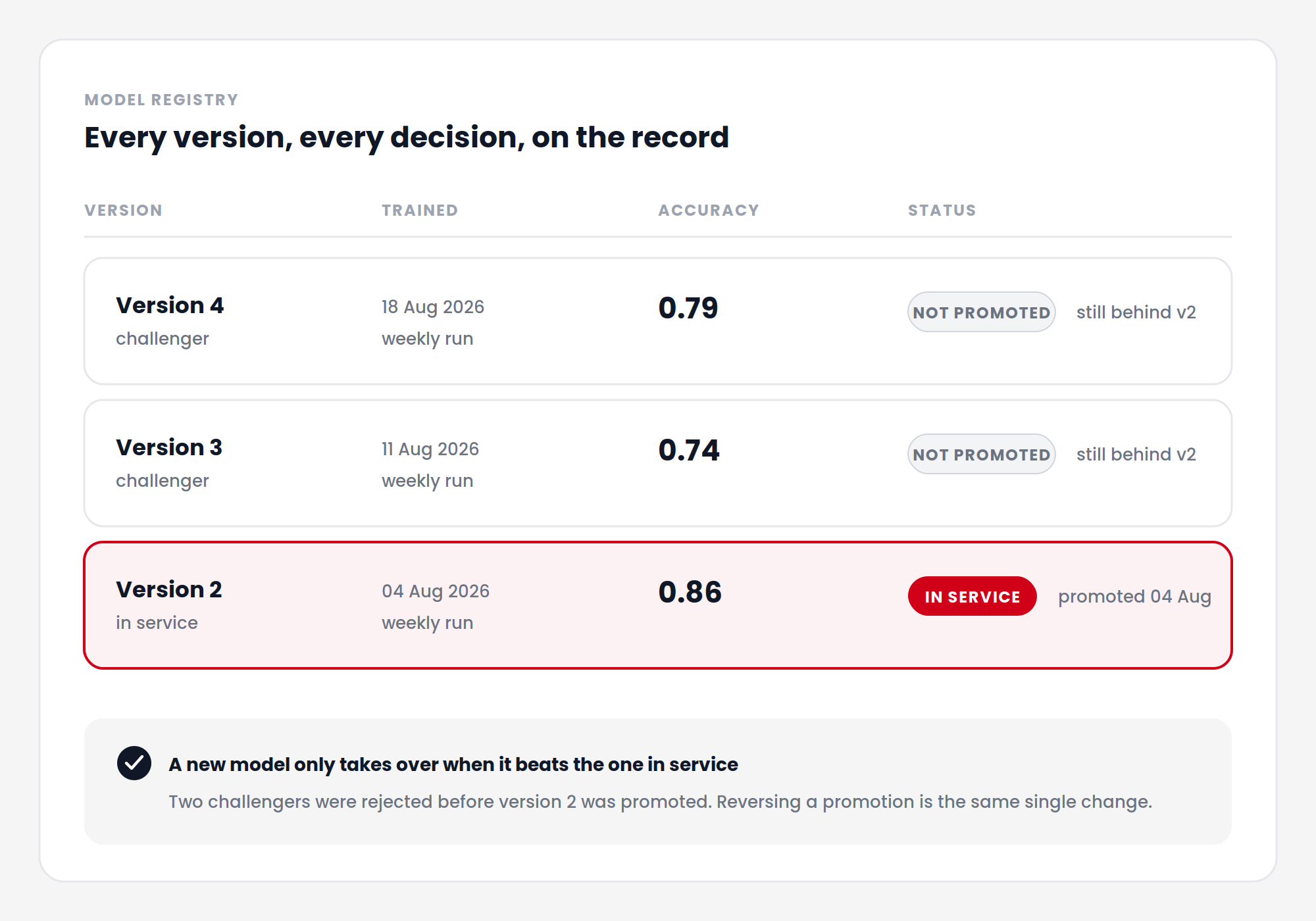
Every decision is logged with the document, the model version, the score and what happened next. Prompts and scores are traced. Every model version records the data and settings behind it.
  • Model access runs through a gateway, so the provider is a configuration choice.
  • Open models already run on infrastructure we control, alongside the hosted ones.
  • Handing the job to a new model is a single logged change, so there is always a record of what took over and when. Undoing it is the same change.
An audit log showing each decision with its model version, score and outcome
Pilot

Start with one decision, not a platform.

Pick one decision your team makes at volume. We put the scoring layer in front of it first, so within weeks you have a number on every call it makes and a gate stopping the weak ones. The verified set starts building immediately.

If the volume never justifies a specialised model, you keep the scoring and the audit trail. That is a valid outcome, and it costs you one process rather than a programme.

Book a 45-minute call

Pilot timeline showing scoring live by week four and the verified set building from week one
Questions

The ones we get asked first.

How is this different from using the AI directly?

The model gives you an answer. It does not tell you how good that answer is. Scoring every one and stopping the weak ones is the difference between a demo and something you can deploy.

What if the specialised model never beats the general one?

Then it never takes over, and you keep the scoring layer. The handover only happens when it wins on your own traffic.

Does this tie us to one AI provider?

No. Access runs through a gateway, so the provider is configuration. Open models on infrastructure you control are already supported.

Who labels the training data?

Nobody. The labels come from readings that already scored perfectly. That is what the loop is for.

Who runs it after launch?

Your platform team. Standard Kubernetes, standard monitoring, standard delivery. Handing over to a new model is a registry change, retraining is a scheduled job.

What does it cost?

While the general model does the work you pay per document. After the handover the specialised model has no per-document charge and you pay for infrastructure. We size both against your volume during scoping.

Next step

Tell us which decision your team makes most often.

We will tell you whether AI can make it, how you would know it was right, and what it would cost.


Book a 45-minute call

The product interface showing a scored decision queue