©IWConnect. All Rights Reserved.
Enterprise Data AI — Semantic Layer
Engineering Intelligence Platform
IWDora shows you which files break most, what each incident costs in engineer hours, and who is the only person who can fix it.
Zero work for your team.
We install it, connect your tools, and send the reports. You just read them.
No commitment. Demo runs on your own data.
Your repo, your incident tool, your project tracker — none of them talk to each other. So no one can answer: which code causes most of our problems, and what is it costing us?
2 to 5 files cause 60–70% of all production incidents. The team fixes the symptom each time. The root-cause file stays in production because nothing connects commit history to incident frequency to cost.
Most teams calculate DORA metrics manually before each review — or not at all. The result is a hedged estimate instead of a data-backed answer.
Critical parts of most codebases are understood by exactly one person. This stays invisible until that person resigns — and the emergency knowledge transfer begins.
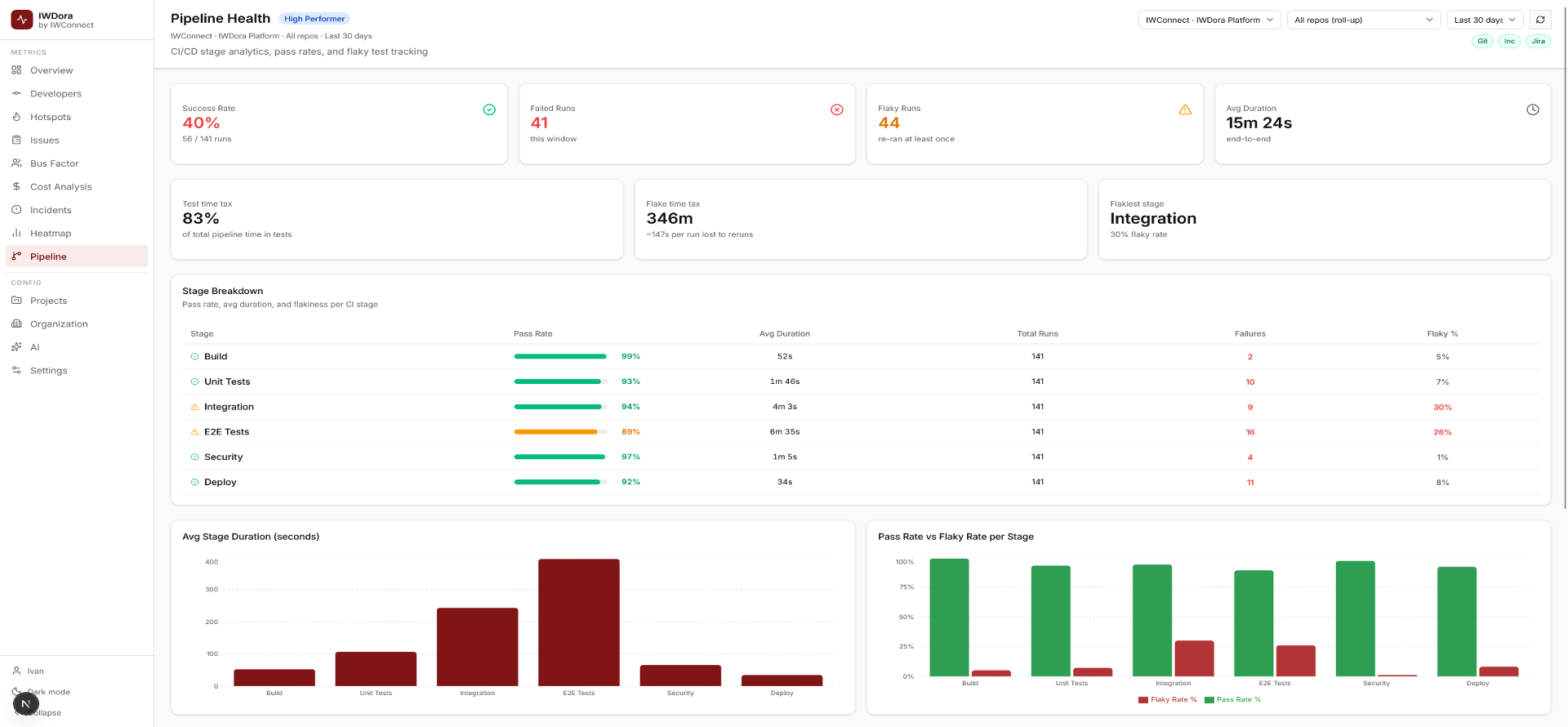
IWDora reads from GitHub or GitLab, PagerDuty or OpsGenie, and Jira — and calculates what those tools individually can't show. Every calculation is transparent and auditable.
A risk score per file — combining change frequency, incident count, and author concentration.
Every incident converted to euros — engineer hours × hourly rate × resolution time, per file.
DORA metrics calculated automatically and benchmarked against industry tiers — always current.
Single-author files flagged proactively — before a resignation turns this into a crisis.
After-hours deploys, weekend commits, and on-call concentration identify teams operating unsustainably — before it becomes an outage.
Monthly digest for engineering leadership. Quarterly C-suite report with AI narrative and one top action.
| Question from leadership | Today | With IWDora |
|---|---|---|
| Is our team getting faster or slower? | DORA metrics assembled manually the week before the review. Usually presented with "we think." | Automated DORA trend, always current — Elite / High / Medium / Low against the State of DevOps benchmark. |
| Which code causes most of our outages? | Unknown. Post-mortems name symptoms. The actual files are never identified. | File risk score combining commit history and incident count. Top 2–5 files named, ranked, and reported monthly. |
| What did our incidents cost last quarter? | Engineer time is never converted to money. The cost stays invisible until it repeats. | Incident cost = duration × hourly rate × severity. Calculated per incident, per file, per quarter. CFO-ready. |
| What happens if our lead engineer leaves? | Nobody knows until it happens. Emergency knowledge transfer starts under pressure. | Continuous bus factor analysis. Single-author files flagged before any resignation forces the issue. |
| Are we getting value from our tooling spend? | €60–80 per developer per month across multiple SaaS tools. Calculations are opaque. | Self-hosted. No per-seat fee. All metrics in one deployment with fully transparent, auditable calculations. |
Three phases. Clear milestones. No surprises — and no work for your team.
We map your toolchain and document the questions your leadership needs answered.
We deploy IWDora, connect your tools, and deliver your first engineering health report — fast.
Leadership gets a quarterly DORA benchmark and an AI-generated board digest — no translation needed.
No lock-in. Take the license and run it independently, or let us manage it. The data and calculations are always yours.
We’ll run a live example – top risk files, incident cost, DORA tier, bus factor. No commitment. No setup on your side.
©IWConnect. All Rights Reserved.