Your filters bring in the list
Sources, regions, keywords, roles. That part you already control, and the items arriving are already broadly relevant.

The agent works through the list they collect, decides which items genuinely fit what you offer, and drafts each message from your own case studies and references. Sales point it at leads, recruiters at candidates, bid teams at tenders, and it works the same way on any list your team answers by hand.
Running inside IWConnect. Up to 100 items read and scored a day.
Sales · hiring signals
Score
Recruitment · candidate pool
Score
Bids · tender portal
Score
Sources, regions, keywords, roles. That part you already control, and the items arriving are already broadly relevant.
It reads the item and works out whether it genuinely fits what you offer, scoring that judgement against your services, your technologies, your certifications and your rules. Broadly relevant and actually worth approaching are not the same thing, and this is where the difference gets decided.
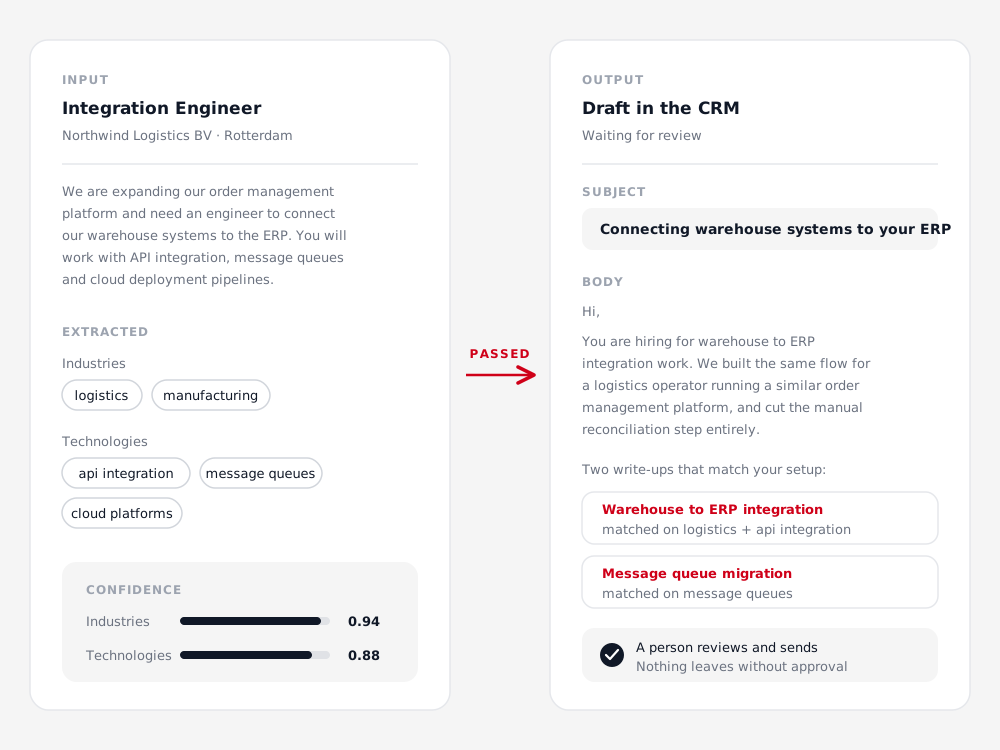
Every item that passes carries the reasons it passed. The agent writes the message from those same reasons, using your real material: the reference that matches, the work you have delivered, the write-up that proves it.
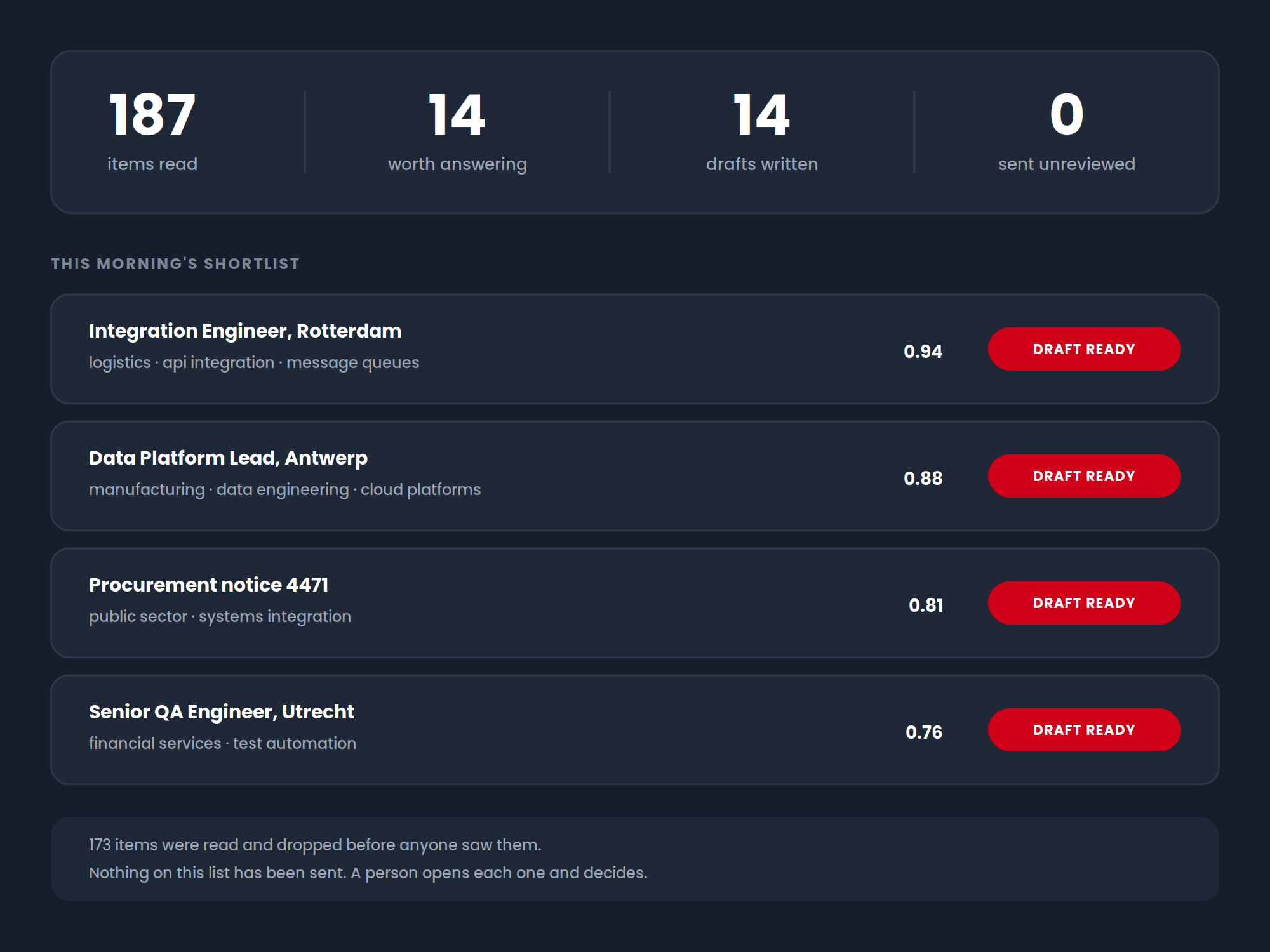
Your team opens a shortlist with drafts attached, instead of working down the full list one item at a time.
Public calls, filtered down to the ones you can actually bid for.
For recruiters, the same logic pointed at people instead of companies.
A company hiring three integration engineers is about to spend on integration.
A round raised is a budget about to be spent.
Records you already hold, scored again against what you offer today.
Set the filters once. Whatever they bring in, the agent works through it item by item.
A list arrives. Someone opens each item, checks it against what you offer, and writes a response to the ones worth answering. That is the whole pattern, and the department doing it makes no difference to the agent.
Find the companies with the need you serve, and open with the reference that proves you have solved it.
Same agent, different target. Read the postings or the candidate pool, score against the role you are filling, and write the approach.
Read the calls as they are published, drop the ones outside what you deliver, and draft around your real references.
Work through inbound applicants or a market list, keep the ones that meet your criteria, and reply to those.
Read the published programmes, keep what your work qualifies for, and draft the first response.
These are examples, not the list of what is supported. If your team does this with something not named here, nothing about the agent changes. Only the sources it reads and the rules it scores against.
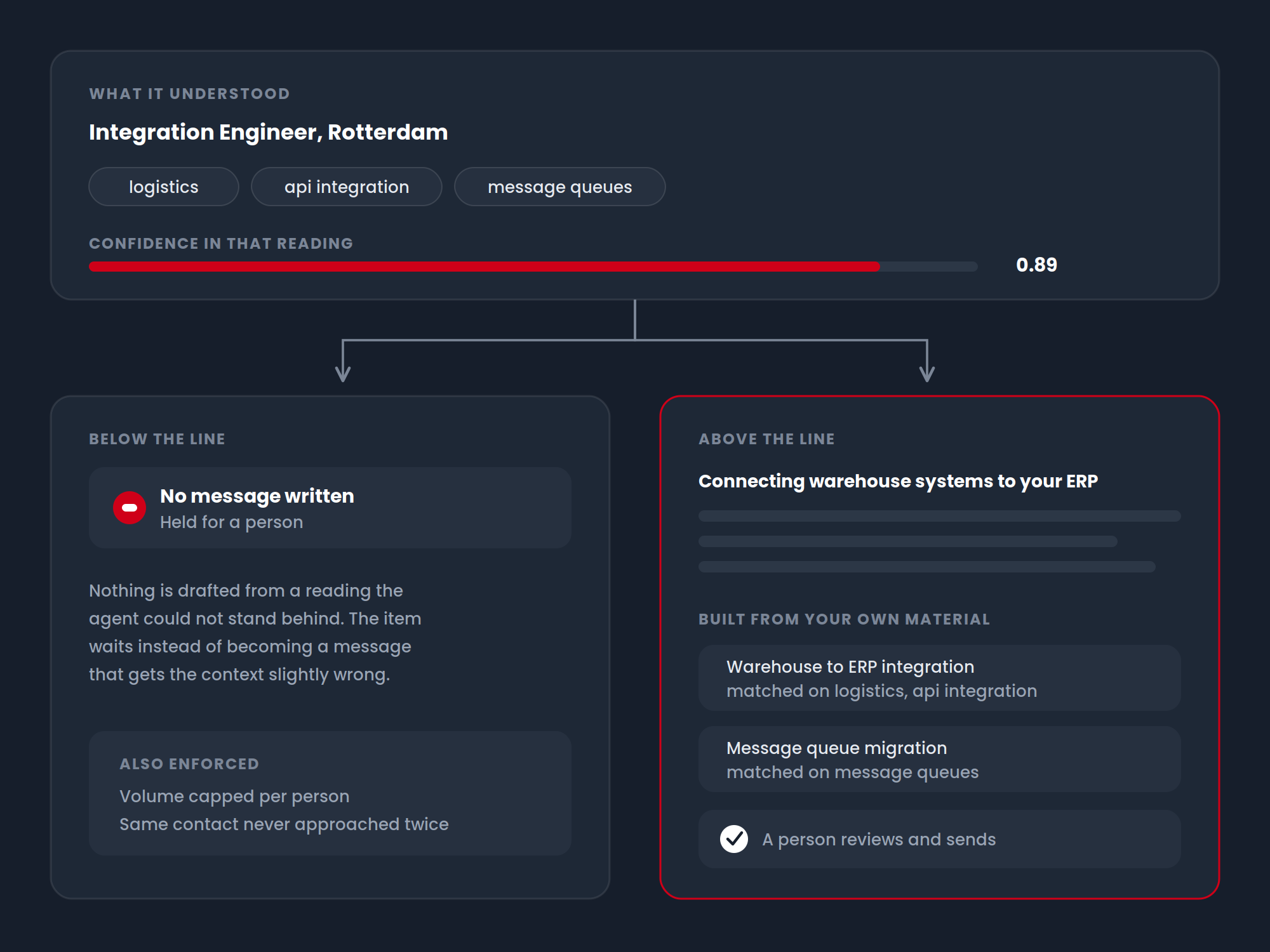
The agent pulls the values that matter out of each item: the industry, the technologies, the requirements. One item can carry several at once.
A panel of models grades that reading against the same standard. One number per value, not an opinion.
Above the threshold, the agent writes the message. Below it, the item stops and waits for a person.
Every reading that scores perfectly is kept. Those become the training set for a specialised model that takes over the same task later, with no charge per item.
Most outreach tools fail the same way. They fill a template, they get the context slightly wrong, and the person reading it can tell within one line.
This agent scores its own reading before it writes anything. An item it half understood never becomes a message. What does get written is built from your real material, so the proof attached to it is the proof that fits.
Every team has one source they check first. Ours is hiring announcements, because a company staffing up on a technology is about to spend on it. Yours might be a tender portal or a candidate pool. The agent does not care which.
The draft lands where the team works. A person reads it and sends it.
Up to 100 posts a day, every day
The agent runs inside IWConnect on our own lead generation.
The specialised model that would replace the general one is still training. It has not yet won, so that handover has not happened. We will show you the live comparison on the call.
The sourcing, the scoring and the drafting are live now.
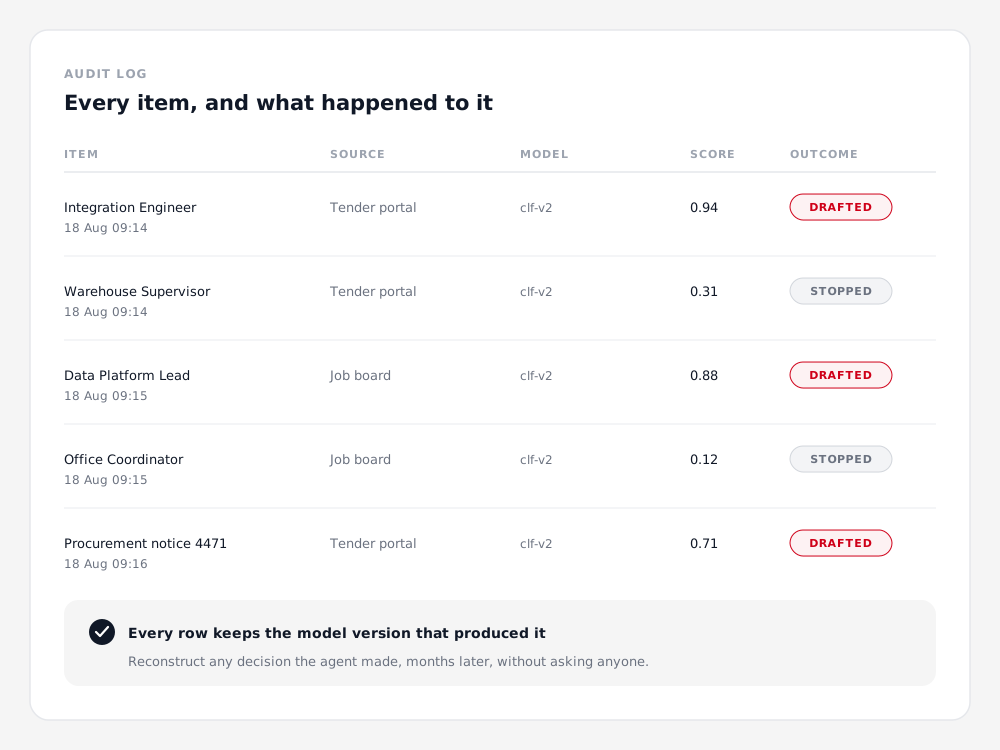
Every item is logged with the source, the model version, the score and what happened next. Prompts and scores are traced. Every model version records the data and settings behind it.
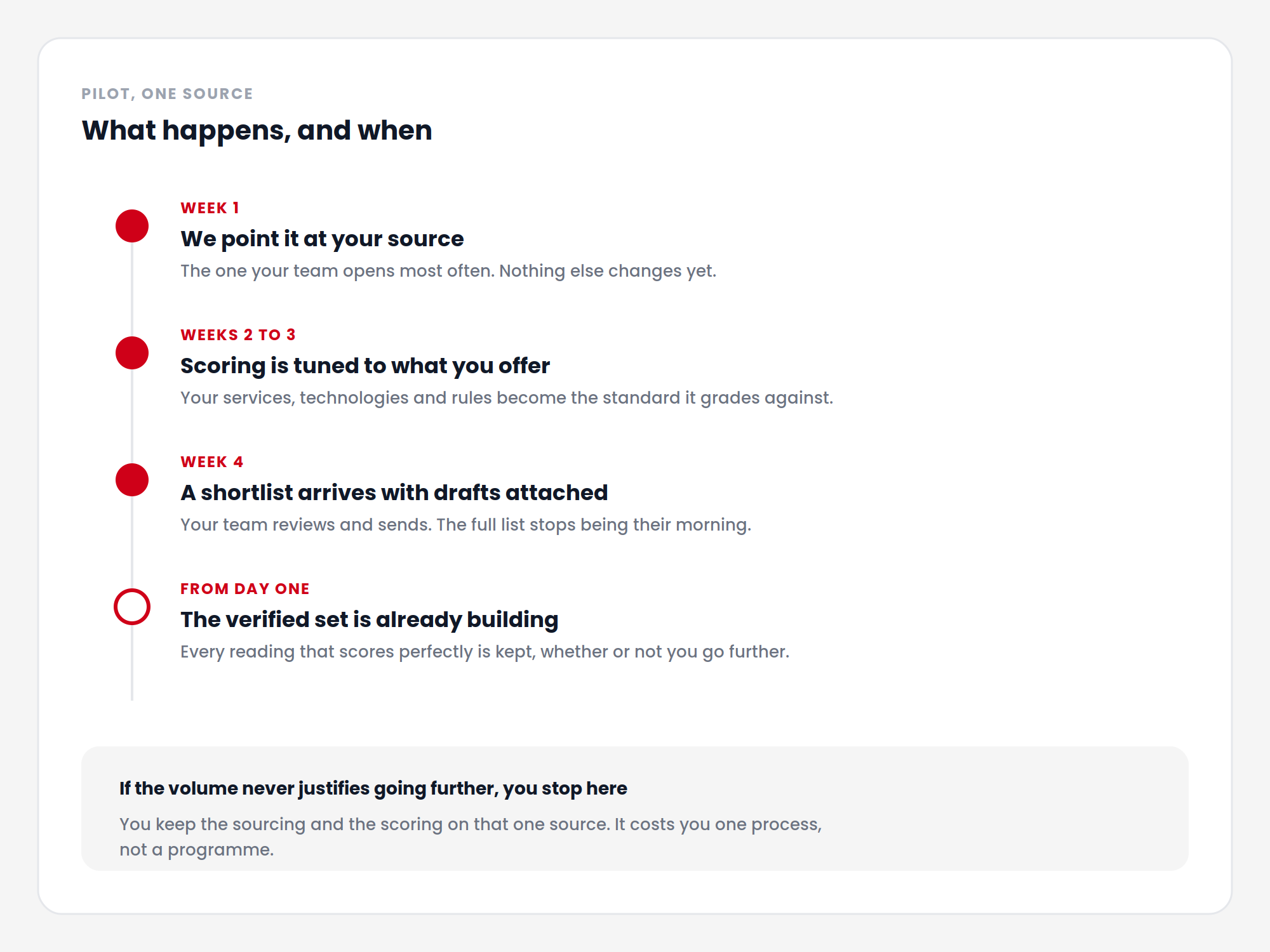
Pick the source your team scrolls most often. We point the agent at it, tune the scoring against what you offer, and within weeks you have a qualified list with drafts attached instead of a feed.
If the volume never justifies going further, you keep the sourcing and the scoring. That costs you one source rather than a programme.
Lead generation is one use of it. The agent reads a list, qualifies each item against what you offer, and writes the response. Any work with that shape fits, whichever team does it.
The agent scores whether it understood the source before it writes. Anything it did not understand well enough never becomes a message.
The message is written for the person and the reason they qualified, not for a channel. Where the draft is delivered is a matter of connecting it to the tool your team already uses. Our own deployment drops drafts into the CRM.
Yes. Your own CRM records and lists work the same way as a public site.
No. Access runs through a gateway, so the provider is configuration.
Your platform team. Standard Kubernetes, standard monitoring, standard delivery.
We will tell you whether the agent can read it, how it would score against what you offer, and what your team would get back.
✕
By signing up for the waiting list now, you'll secure your spot for early access and claim these valuable benefits.