

In the rush to deploy Generative AI, many enterprises fall into the same trap: building an application entirely on Large Language Models (LLMs). While LLMs offer incredible flexibility and rapid prototyping speed, relying on them to run every operational step in a production pipeline quickly exposes critical bottlenecks: unsustainable token expenses, latent execution speeds, and systemic drift.
To build a truly sustainable, production-grade AI system, you must transition from an LLM-only application to a Hybrid AI Architecture.
This case study breaks down a high-level blueprint that integrates LLM flexibility, traditional Machine Learning efficiency, and rigorous AI Evaluation. By orchestrating these components correctly, we built an automated, data-driven B2B outreach pipeline that maximizes semantic intelligence while making LLM cost optimization a core design goal.
The outreach problem
For B2B service providers, high-impact outbound sales rely entirely on proof of capability. When a prospective client posts a job opening on LinkedIn, it signals an immediate, funded need. The most effective way to win that business is to respond rapidly with a highly personalized pitch showcasing exactly how your company has solved identical problems before.
Behind the scenes, this requires mapping an incoming Job Posting (demanding specific tech stacks, roles, and industry expertise) to a deep corporate repository of Case Studies (detailing past architectures, delivered solutions, and industry outcomes).
This process includes: Classification of the industries and technologies mentioned in the job post, Retrieval of relevant case studies from the company portfolio, and generation of an email referencing the relevant case studies to be showcased to the potential outreach target.
Phase 1: Rapid Deployment via the Application Layer (RAG)
To launch the solution quickly and capture market value immediately, the pipeline initially relies on the contextual intelligence of LLMs.

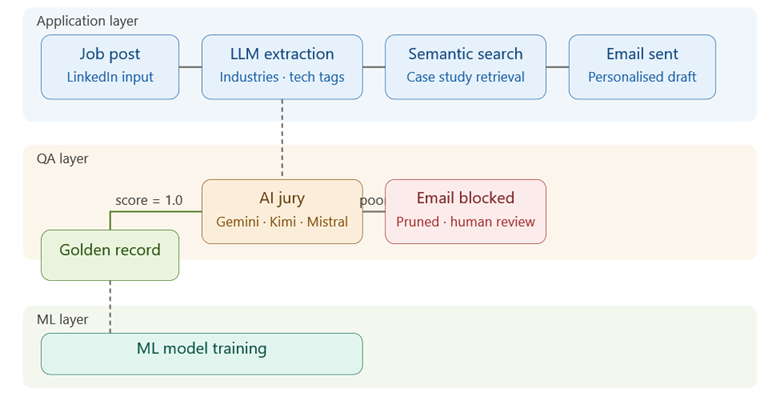
- Ingestion & Summarization: The application continuously ingests real-time job postings from LinkedIn, stripping away noise to create a clean text summary.
- Semantic Feature Extraction: To find the perfect case study match, the system must accurately deduce the required industries (e.g., Financial Services) and technologies (e.g., .NET Core, Azure Cloud) hidden within the job text. A foundation model (such as GPT) handles this initial classification task.
- Targeted Matching & Personalization: Using these extracted features, the application performs a semantic hybrid search against the company portfolio. It isolates the top matching case studies, passes them to a generation prompt, and drafts a highly personalized outreach email referencing proven corporate achievements.
Phase 2: The QA Layer as an Automated “Golden Record” Factory
To bridge the gap between expensive LLMs and low-cost ML, the architecture introduces an advanced, automated Quality Assurance layer utilizing the LLM-as-a-Judge methodology.
Instead of relying on a single model to grade itself, the system routes the application’s classification results through a diverse AI Jury composed of distinct model families (e.g., Gemini, Kimi, and Mistral). This allows to further increase performance scoring objectivity, as models from different families reach a consensus on the LLM Classification score.
The scoring is a custom F1 score ranged from 0 to 1, with 1 being the strongest.
Programmatic Data Gates
- The Unanimous Pass (Score = 1.0): If all three jury models independently agree that the classification is flawless, the record is flagged as a Golden Record and stored in the central Golden Dataset.
- The Pruning Gate (Score < 1.0): If the jury detects a potential hallucination or mistake, the sample is instantly blocked from moving forward in the RAG pipeline. These records are set aside for optional human verification.
This process prevents low-quality, mismatched data from driving the outreach engine, protecting the company’s brand reputation.

Phase 3: Retiring the LLM – LLM Cost Optimization in Practice
This is where our LLM cost optimization pays off: we turn an ongoing operational expense (API tokens) into a fixed, highly optimized corporate asset.
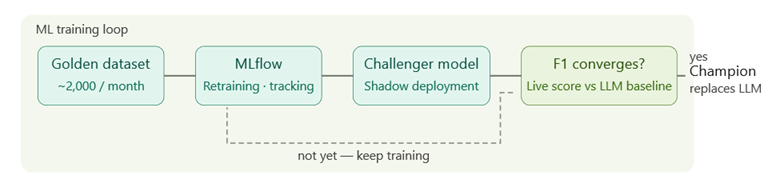
With a steady stream of roughly 2,000 new job posts ingested monthly, the automated QA layer rapidly builds a massive, high-fidelity labeled dataset. This structured data is used to train localized, lightweight traditional Machine Learning classification models.
Real-Time Financial & Performance Shadowing
Using MLflow, engineering teams continuously run experiments and track model retraining. In production, the system runs a continuous “shadow deployment.” Every incoming job post is classified by both the active LLM and the challenger ML model.
Because the AI Jury actively scores every transaction, the system generates real-time, side-by-side score tracking comparing the ML model against the LLM. This allows to continuously monitor how the ML model improves with each training cycle, and signals when it is ready to be used in the production pipeline instead of the LLM Classifier.
The Cut-Off Moment

The moment the data dashboard shows that the ML model’s score has converged with or exceeded the LLM’s accuracy, the engineering team pulls the lever.
The expensive LLM is completely removed from the classification pipeline, and the local, specialized ML model takes over inference at near-zero runtime cost.

Realized Business Value
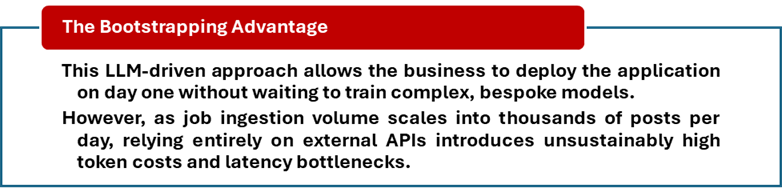
For our email outreach project, we have managed to build and deploy a fully automated, personalised outreach engine from the ground up — something that would have been impossible to bootstrap without LLMs handling the heavy lifting of classification from day one.
As the pipeline matured, integrating AI Evaluations through our multi-model jury gave us the confidence to trust the system’s outputs at scale: hallucination rates dropped significantly, and every email sent was backed by a verified, high-quality classification.
Over time, as our Golden Dataset reached 10,000 labelled samples, our lightweight ML classifier converged to match LLM-level accuracy — allowing us to fully substitute the LLM in the extraction step and cut classification costs dramatically, without any loss in output quality.

- Zero-To-Market Speed: By bootstrapping the application with LLMs initially, the business captures immediate value and begins automated outreach on day one without prolonged development cycles.
- LLM Cost Optimization at Scale: Swapping costly multi-label LLM token calls for a localized, specialized ML model drops operational execution costs by up to 90% as transaction volume scales.
- Automated Data Flywheel: The system processes unlabeled, raw internet data and converts it into a proprietary corporate data asset (the Golden Dataset) entirely through automated pipelines.
- Guaranteed Brand Safety: The multi-model AI Jury acts as a strict programmatic gatekeeper, ensuring that prospective clients are only pitched with highly accurate, relevant past experiences, completely eliminating damaging AI hallucinations.