
The Problem:
At first, the process worked exactly as intended.
Leads were coming into Salesforce from multiple channels – website forms, paid campaigns, and partner referrals. The Revenue Operations team reviewed them. The Business Development team validated them.
But as the company started to grow, the cracks began to show.
Every day, more than 200 new leads entered the system. Each one needed a manual check:
- Who is this person?
- Is this company relevant to our target market?
- Is there real buying intent?
The Revenue Operations team would assign an initial score. The Business Development team would review it, and often re-score the same lead. Sometimes the scores matched. Often, they didn’t.
The consequences were predictable:
- High-value leads were contacted too late
- BDRs spent hours chasing low-quality prospects
- No clear audit trail existed for scoring decisions
- 6–8 hours every day were spent reviewing leads
What once worked for a smaller pipeline not holding up anymore. Growth wasn’t the problem, the real challenge was making good decisions at scale.
The organization didn’t just need more automation. It needed intelligence built directly into the lead qualification process.
The Strategic Decision:
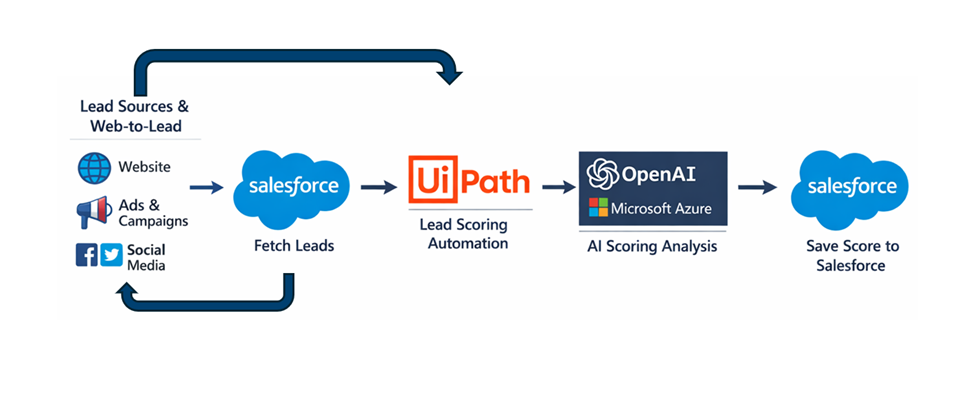
Instead of adding yet another rigid, rule-based scoring model inside Salesforce, the team chose a different approach, one built around three specialized systems working together:
- Salesforce as the system of record
- UiPath as the orchestration and automation engine
- Azure OpenAI (powered by OpenAI technology within Microsoft Azure) as the intelligence layer
Each platform was chosen for a specific job. Salesforce remained the central source of truth, storing lead data, scores, and outcomes. The complex logic was moved out of Salesforce and handed off to UiPath. UiPath was the right choice here because it can interact directly with applications on screen, performing actions like clicking and navigating where APIs aren’t available.
Technical Architecture:
The solution runs as an asynchronous, API-driven integration. Instead of embedding heavy logic directly in the CRM, it uses event-driven automation and external AI processing to evaluate leads without slowing anything down.
Flow Overview
- Leads enter Salesforce through multiple channels – web forms, paid campaigns, and partner referrals.
- Each lead is automatically tagged with a “Pending Scoring” status, flagging it for AI evaluation.
- UiPath authenticates with Salesforce via OAuth 2.0, keeping access secure and controlled.
- UiPath pulls the relevant lead attributes needed for scoring (company data, job title, industry, source, etc.).
- A structured data payload is sent to Azure OpenAI for intelligent evaluation.
- The AI model returns three key outputs:
- Lead Score
- Confidence Level
- Reasoning Explanation
- UiPath validates the response and handles any errors to make sure the data is clean.
- The Lead record in Salesforce is updated with the scoring results.
- The full transaction is written to a custom logging object, creating a complete audit trail.
The result is a fully automated qualification pipeline:
- No manual touchpoints.
- No subjective scoring decisions.
- Just consistent, explainable, AI-assisted lead evaluation.
Salesforce Configuration (System of Record)
The Salesforce layer was kept clean and simple on purpose, built for API-driven integrations. , not weighed down with scoring logic.
Salesforce stores the AI-generated results and keeps a clear, maintainable data model. The thinking happens elsewhere.
Custom AI Fields on Lead:
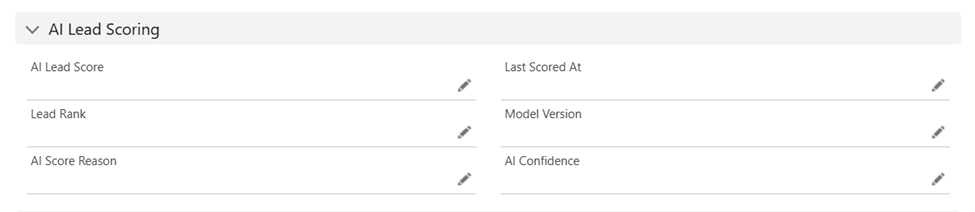
To hold the scoring outputs, several custom fields were added to the Lead object:
- AI_Lead_Score__c (Number 0–100) – the numerical score the AI assigned to the lead.
- Lead_Rank_c (Picklist) – a category label (Hot, Warm, or Cold) based on the score.
- AI_Score_Reason__c (Long Text Area) – a plain-language explanation of why the lead got that score.
- Last_Scored_At__c (DateTime) – when the lead was last evaluated.
- Model Version (Text) – which AI model version produced the score, for traceability.
- AI_Confidence__c (Percent) – the model’s confidence in the score it returned.
A dedicated custom object –Lead_Scoring_Log__c – was also set up to record every scoring transaction in full, including the request payload, returned score, confidence level, and timestamp.
This is what keeps the system honest. No AI decision disappears into a black box. Every score can be traced back to exactly what data the model received and what it returned. Teams can review the history, spot patterns in model behavior, and stay accountable for every call the system makes.
Secure Integration Setup:
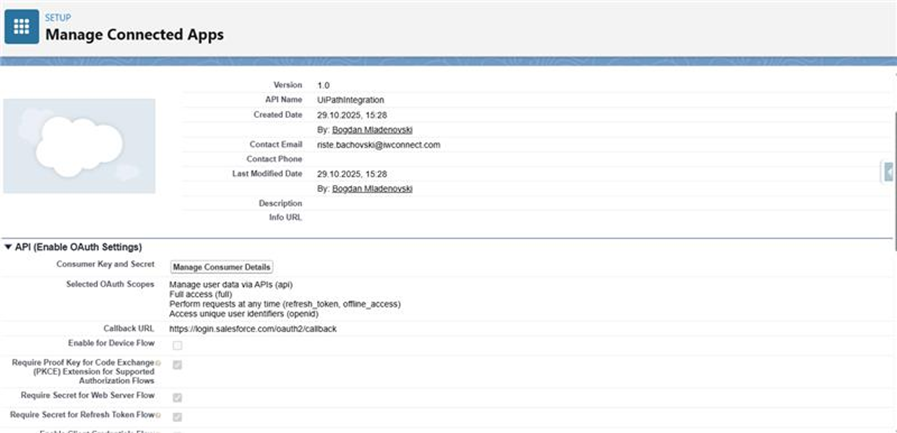
A Connected App was configured in Salesforce to handle secure communication between systems:
- OAuth 2.0 authentication for token-based access
- A dedicated API-only integration user to keep automation activity isolated
- Scoped permissions following the principle of least privilege
- Encrypted communication (TLS 1.2+) to protect data in transit
This keeps the integration secure, auditable, and compliant, built to hold up under the scrutiny of any enterprise security review.
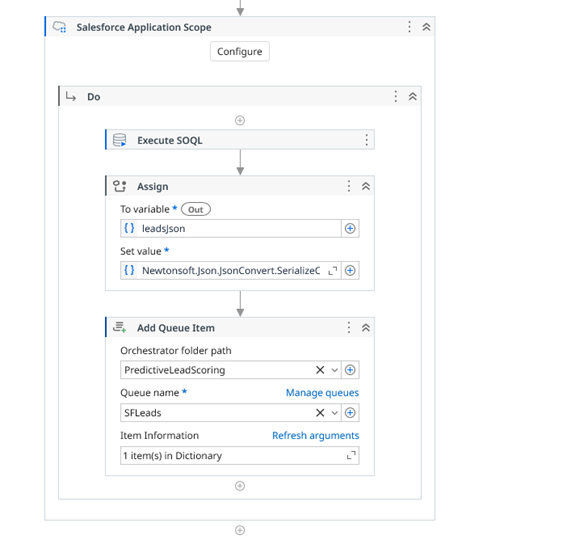
UiPath connects to Salesforce using that OAuth 2.0 token-based access and handles everything the scoring process needs from the CRM side:
- SOQL queries to find records marked for scoring
- Bulk updates to write AI scoring results back to Salesforce
- Log record creation in the Lead_Scoring_Log__c object for full auditability
To keep performance solid and avoid unnecessary load on Salesforce, the integration uses the Salesforce Bulk API and Composite API. These allow efficient batch processing and keep governor limit consumption low, so the system holds up as lead volumes grow.
UiPath: The Orchestration Engine
UiPath is what ties the whole system together. It manages data flow between platforms, runs the automation logic, and makes sure every scoring transaction completes reliably.
The automation was developed in UiPath Studio and deployed through UiPath Orchestrator, giving the team centralized monitoring, scheduling, and error management in one place.
Core Components Used
- Salesforce Connector for structured, secure interaction with Salesforce APIs
- Azure OpenAI HTTP Activities to send lead data for AI evaluation
- Retry Scope to automatically handle transient API failures without manual intervention
- JSON Schema Validation to ensure the AI response follows the expected structure before anything is written back
- Queue-based transaction model to process leads individually and ensure fault tolerance so a single failure doesn’t affect the rest of the batch
AI Layer – Azure OpenAI
The intelligence runs on a GPT-based model deployed inside Azure OpenAI, keeping everything within Microsoft’s security and compliance environment.
This isn’t a simple “score this lead” prompt. The model gets clearly defined input data, specific evaluation criteria, and strict output requirements.
That structure is what makes the results consistent and predictable enough to run in a live sales pipeline without a human double-checking every output.
System Role Definition
The AI model was configured with a strict system role and fixed response format. This stops it from returning freeform answers and makes sure the output is always clean enough for UiPath to consume programmatically.
The model is instructed to operate as a sales qualification assistant, it evaluates each lead and returns a structured assessment.
AI Role Instruction
For each lead, the model is instructed to return:
- Score – an integer from 1 to 100 representing overall lead quality.
- Confidence – a decimal between 0 and 1 showing how confident the model is in the score.
- Priority – a classification based on score and business value: Hot, Warm, or Cold.
- Reason – a concise explanation of why the lead received the assigned score and priority (maximum 30 words).
Priority Classification Rules
- Hot – Score ≥ 80
- Warm – Score 60–79
- Cold – Score < 60
Structured Output Requirements
Because UiPath consumes the response programmatically, the output format is locked down tight:
- The response must be valid JSON.
- The output must be returned as a JSON array.
- The response must start with “”[“” and end with “”]””.
- No markdown formatting is allowed.
- No “`json or “` markers may be included.
- No explanations, comments, or additional text may appear outside the JSON structure.
- The response must be fully parseable by a standard JSON parser.
These constraints keep the AI output deterministic and machine-readable, no ambiguity for the automation layer to deal with.
Required JSON structure:
[
{
			""Id"": ""00QXXXXXXXXXXXX"",
			""Score"": 85,
			""Confidence"": 0.9,
			""Priority"": ""Hot"",
			""Reason"": ""Example explanation""
		}
]
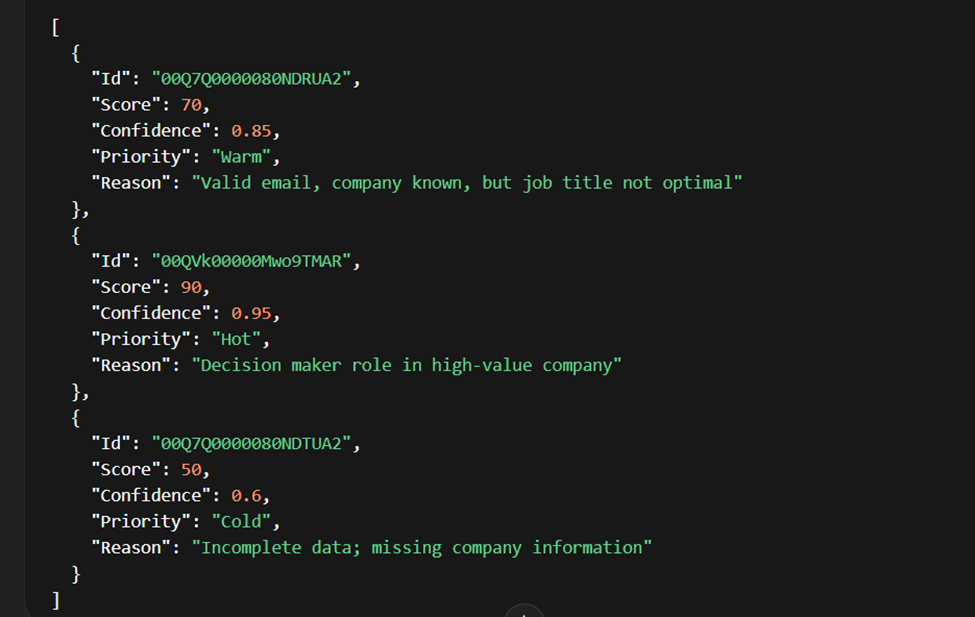
Here’s what the actual results look like coming back from the model:
UiPath validates every response:
Before any AI result gets written back to Salesforce, UiPath runs a strict validation check to catch anything malformed before it touches the data.
The automation checks:
- Score must be within the range 0–100
- Confidence must be within the range 0–1
- Reason must not be null or empty
- The response must contain a valid JSON structure
If any of those checks fail, the lead record stays untouched. The lead gets flagged as “Failed” and the full transaction details are logged in Lead_Scoring_Log__c for investigation. Nothing gets silently corrupted.
Performance Optimization
A few architectural decisions keep the system running fast without putting unnecessary pressure on Salesforce:
- Bulk API for efficient batch updates
- Composite API requests to minimize API calls
- No synchronous Apex triggers, these were deliberately excluded to avoid unnecessary processing overhead during updates
The architecture is also stateless and built to scale horizontally, meaning it can handle more leads without any performance drop as volumes increase.
The Transformation
The impact was immediate and easy to measure.
Before the implementation:
- ~8 hours per day spent on manual lead review
- Subjective and inconsistent scoring between teams
- Delayed follow-up with high-value prospects
- No clear audit trail for scoring decisions
After the implementation:
- <15-minute scoring turnaround from lead creation to qualification
- Consistent AI-driven scoring across all leads
- Explainable reasoning attached to every score
- Complete transaction history for auditing and reporting
- Sales prioritization based on intelligent insights
Final Thought
This didn’t just automate an existing process, it replaced the process entirely. Instead of manual reviews and static scoring rules, the team built an AI-driven architecture on top of Salesforce. Salesforce remains the system of record, UiPath orchestrates every transaction and integration flow, and Azure OpenAI provides contextual intelligence and the reasoning behind every score.
The result goes beyond saving time.
It turns lead qualification into a structured, auditable AI process, one that evaluates every incoming lead the same way, every time, at any volume.
This isn’t about doing manual work faster. It’s about not doing it at all, replacing it with consistent, explainable, intelligent decision-making built directly into the sales pipeline.
Authors: Sara Koleska and Riste Bachovski