Challenge
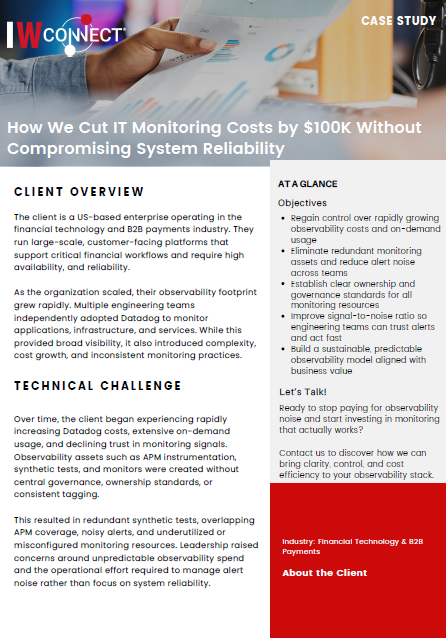
A US-based fintech enterprise running critical B2B payment platforms faced rapidly escalating Datadog costs and declining monitoring effectiveness. Multiple engineering teams had independently adopted observability tools without central governance, creating redundant synthetic tests, overlapping APM coverage, and noisy alerts. The result: unpredictable spending, extensive on-demand usage, and teams spending more time managing alert noise than improving reliability. Leadership needed to regain control over observability spend while maintaining system reliability for customer-facing financial workflows.
Solution
Our SRE team conducted a comprehensive audit of Datadog usage across all environments, services, and teams. Working collaboratively with stakeholders, we identified which monitoring truly supported business-critical operations and which drove costs without providing value. We then implemented a structured optimization program:
- Removed monitoring from non-customer-facing environments
- Consolidated and refined synthetic tests based on actual service criticality
- Optimized APM configurations through targeted sampling
- Refined alert thresholds and removed non-actionable monitors
- Established governance standards with consistent tagging and ownership
Business Value
The engagement delivered approximately $100,000 in annual cost avoidance while significantly improving operational effectiveness. APM costs were stabilized within committed plans (avoiding $70,000–$90,000 in on-demand spend), and Synthetic Monitoring costs dropped 70%. Beyond cost savings, the organization gained predictable budgets, clear ownership across monitoring assets, and more reliable signals—enabling faster incident detection and resolution with fewer false alerts.
Download the full case study to learn our complete methodology and implementation approach.