
Introduction: The New Business-Critical Layer of the Energy Sector
As the global energy sector accelerates its transformation toward a decentralized, renewable-heavy system, a profound shift is occurring. The software platforms that manage market coupling, energy auctions, and grid congestion have evolved from back-office tools into mission-critical infrastructure. As the grid becomes more complex and interconnected, the digital layer governing its operation is now as vital as the physical poles and wires. This software is no longer just supporting the business, it is the business.
For Transmission System Operators (TSOs), Nominated Electricity Market Operators (NEMOs), and market platform providers, this shift fundamentally changes where operational risk resides. Incidents are no longer confined to physical assets alone, they increasingly originate in late results, inconsistent data, misaligned fallback logic, or performance bottlenecks within digital market infrastructure.

This transition is driven by a convergence of intense pressures that are reshaping the industry’s risk landscape and elevating the role of quality. These are not merely technical hurdles; they are fundamental business imperatives that demand a new level of rigor and foresight.
- Decarbonization and Renewables: The integration of variable energy sources, aggregators, and Distributed Energy Resources (DERs) introduces unprecedented market volatility and operational complexity, stressing legacy systems and conventional operating models.
- Grid Stability and High Availability: In the energy sector, “high availability is not a marketing phrase or a system metric, it is the difference between a stable continent and cascading blackouts.” The stakes are absolute, and the tolerance for failure is zero.
- Regulatory and Compliance Demands: Strict rules and unforgiving deadlines, such as those mandated by Europe’s Clean Energy Package, transform operational metrics into non-negotiable compliance obligations with significant financial and legal consequences.
- Scalability and Performance: The move to 15-minute Market Time Units (MTUs) is a prime example of the new performance reality. This shift quadruples the volume of data that must be processed under even tighter deadlines, pushing system architecture to its limits.
- Cybersecurity and Data Reliability: As critical national infrastructure, these digital platforms are high-value targets. Moreover, the trust that market participants and regulators place in the system is entirely dependent on the verifiable reliability of its underlying data.
In this high-stakes environment, Quality Assurance (QA) has evolved far beyond its traditional role of feature validation. It has become Quality Engineering (QE), a strategic capability essential for ensuring business continuity, maintaining regulatory confidence, and underwriting market stability itself. Quality Engineering has become a control mechanism for digital energy systems, one that enforces determinism, protects regulatory timelines, and ensures that market and grid operations behave predictably under stress.
The Proving Ground: Energy Use Cases Where Quality Engineering is Essential
While quality engineering is critical across the entire energy value chain, its importance becomes most visible in the complex, high-stakes systems where financial, regulatory, and physical realities converge. It is here that a software defect can propagate across national borders in minutes, with immediate and cascading consequences. The core of Europe’s coupled electricity market, the day-ahead and intraday auctions, serves as the ultimate proving ground for mission-critical quality.

In energy auctions, the role of QE is to validate that sophisticated algorithms like EUPHEMIA and XBID operate flawlessly under extreme constraints. This testing transcends simple functional correctness to ensure that every outcome is both economically valid and physically possible. A result that is technically correct but produces irrational prices or violates grid physics is an absolute failure. In live operation, even a single incorrect marginal price can cascade across bidding zones within minutes, triggering disputes, re-runs, or regulatory escalations. Our validation focuses on confirming the mathematical and business integrity of every transaction, including the correct maximization of social welfare, accurate calculation of congestion rent, and the precise alignment of marginal prices with physical grid constraints.
For grid congestion management, as the industry moves from simple Net Transmission Capacity models to more complex Flow-Based allocation, QE acts as the final safeguard between mathematical abstraction and physical reality. We validate that market-clearing algorithms fully respect the intricate power flow interactions across the grid, ensuring that a financially attractive trade does not trigger a physical overload on a transformer or transmission line. In practice, this validation is often the last safeguard preventing a mathematically sound result from becoming an operational incident. This includes validating compliance with key regulatory obligations, such as the rule requiring Transmission System Operators (TSOs) to offer at least 70% of transmission capacity for cross-zonal trade, ensuring that calculated, reported, and offered capacity are perfectly aligned.
The same foundational principles of ensuring reliability, data accuracy, and compliance are paramount in other critical areas of the energy ecosystem:
- Asset management and predictive maintenance solutions
- Renewable energy and storage systems
- Customer portals, billing, and regulatory reporting platforms
Understanding these specific use cases reveals a set of underlying challenges that make quality engineering in this domain a uniquely demanding discipline.
Navigating the Complexity: QE Challenges Unique to the Energy Domain
Testing energy systems is fundamentally different from testing software in other sectors. Here, software errors “do not degrade gracefully.” They manifest immediately as incorrect prices, grid instability, or regulatory breaches. These are not mere integration challenges; they are latent business risks hidden at the seams of the ecosystem, where a single data mismatch can trigger cascading financial and regulatory failures.
- Extreme Integration Complexity Energy markets are not single applications but a vast, interconnected network of heterogeneous systems. This ecosystem blends modern IT with operational technology (OT), IoT devices, APIs, and legacy platforms operated by TSOs, Nominated Electricity Market Operators (NEMOs), Distribution System Operators (DSOs), and thousands of market participants. The complexity is growing exponentially with decentralization, as millions of Distributed Energy Resources, like electric vehicles, solar PV installations, batteries, and heat pumps, participate via aggregators and Virtual Power Plants. Failures rarely occur within a single system; they hide in the integration points, where mismatched assumptions and timing issues can destabilize the entire market.
- Real-Time Data and Unforgiving Deadlines Market systems operate under absolute time constraints where a result delivered seconds late is a complete failure. There is no room for manual correction or a “fix in the next patch.” For example, if Intraday Auction results are delayed beyond their defined deadline, the entire auction must be automatically canceled to prevent the same transmission capacity from being allocated twice. Validating these time-critical processes is a core QE responsibility.
- Mandatory Negative Scenario Validation In most industries, negative scenarios are treated as edge cases. In energy markets, they are “first-class requirements” explicitly defined by market rules. QE is responsible for rigorously testing these failure conditions: What happens if a region cannot participate in an auction? What if capacity data changes moments before gate closure? We must validate that fallback procedures trigger cleanly, automatically, and without ambiguity. Failure to handle these scenarios correctly is not a software bug, it is a compliance breach. Many post-incident investigations begin not with faulty logic, but with fallback behavior that was insufficiently validated under real market conditions.
- Ensuring Resilience and Performance Under Volatility The rise of renewables introduces volatility that systems must withstand, not just accommodate. Extreme price events, scarcity situations, and rapid ramps in generation test the very robustness of market logic. QE must validate that platforms remain stable, deterministic, and that their results are reproducible and auditable even during these periods of extreme market stress. A system that only functions under normal conditions is not fit for purpose in the modern energy sector.
Addressing these systemic risks requires more than just testing tools; it demands a partner with proven experience in engineering quality into the very fabric of these complex systems.
From Theory to Practice: Our Experience Delivering Mission-Critical QE
Effective quality engineering in the energy sector cannot be improvised. It is built on a foundation of deep domain knowledge, structured processes, and an unwavering focus on mission-critical business outcomes. Our approach is designed to de-risk complex digital transformation programs and ensure systems are ready for the rigors of live operation. Our capabilities are framed as strategic solutions to the sector’s primary challenges:
- Verifying Algorithmic and Business Logic Integrity: Our teams possess the domain expertise to go beyond black-box testing. We validate the mathematical integrity of complex auction and clearing algorithms, ensuring that market outcomes are not only technically correct but fully compliant with complex business rules and regulatory frameworks, thereby securing financial and operational correctness.
- De-risking System-Wide Go-Lives: We play a central role in orchestrating large-scale simulations like “Trial Periods and Member Testing.” These exercises bring together all market participants to proactively identify and neutralize the complex interoperability risks, related to mismatched assumptions, timing conflicts, and data inconsistencies, that individual participants cannot see in isolation.
- Engineering Performance for Unforgiving Deadlines: We focus heavily on performance, stress, and endurance testing to guarantee that systems are deterministic under peak load and that latency does not accumulate. Through rigorous automation within CI/CD pipelines, we ensure platforms meet their stringent operational deadlines consistently, preventing costly failures.
- Building Comprehensive Security and Resilience: Recognizing that these platforms are critical infrastructure, security is embedded in every phase of our process. We validate failure recovery mechanisms to ensure operational stability is maintained even when components fail, protecting both continuity of supply and market integrity.
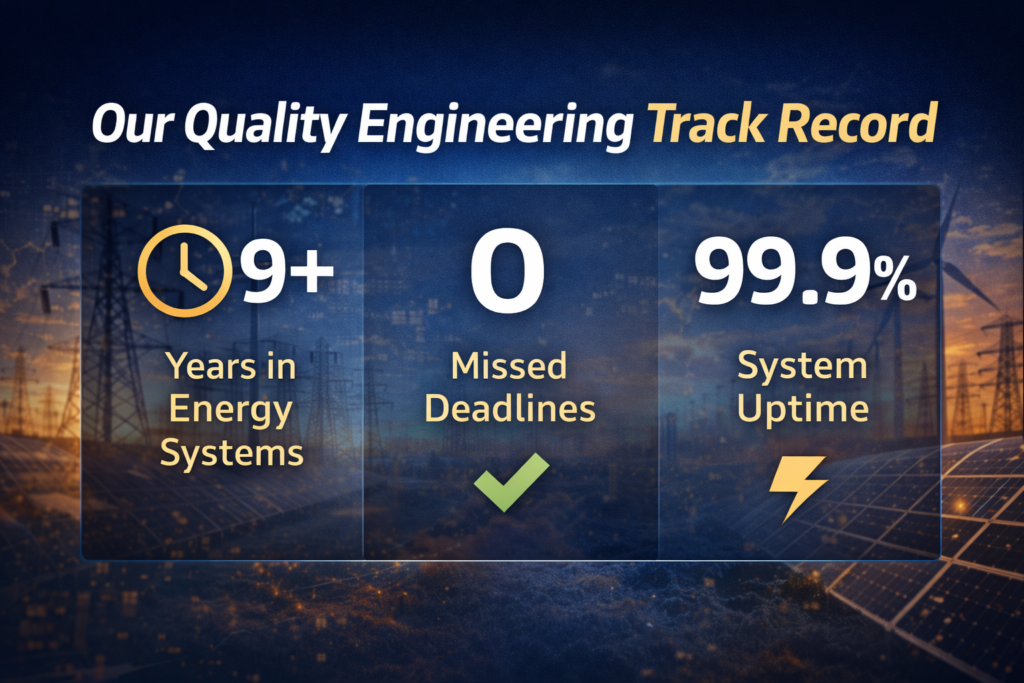
This hands-on experience is grounded in a track record of tangible results. With more than 9 years of experience in the energy sector, our work has been delivered with zero missed deadlines and has contributed to achieving 99.9% uptime for systems that must operate continuously. This is the standard of quality required when a system’s failure can impact an entire continent.
The Strategic Value: What Quality Engineering Truly Protects
In the modern energy ecosystem, quality engineering should not be viewed as a cost center or a final gate before deployment. It is a strategic enabler of business value and a primary mechanism for de-risking an organization’s most vital operational, financial, and reputational assets. Robust QE delivers multifaceted value by protecting the core pillars of a healthy energy market:
- Protecting Market Integrity and Financial Certainty: By ensuring fair, transparent, and correct price formation, QE prevents outcomes that could erode market confidence, create financial distortions, or provide unfair advantages.
- Operational Stability & Grid Security: By validating that market outcomes are always physically feasible, QE directly protects the stability of the grid. It prevents trades that could cause overloads and validates that systems can handle the volatility of renewables, preventing costly and dangerous outages.
- Regulatory Compliance & Confidence: QE is the front line of defense for compliance. It rigorously enforces deadlines, validates fallback rules, and ensures reporting accuracy, giving organizations the confidence that they are meeting their strict regulatory obligations and avoiding serious breaches.
- Trust and Transparency: Ultimately, by ensuring consistency, reliability, and fully auditable results, quality engineering builds trust. It provides the proof that regulators, market participants, and the public need to have confidence in the digital platforms that underpin the entire energy transition. This level of confidence does not come from tools alone, it is built by teams who understand how market rules, grid physics, regulatory deadlines, and system behavior intersect in live operation.
When quality engineering works as it should, nothing happens. There are no incidents, no emergency calls, and no negative headlines. That silence is not accidental, it is engineered.
Conclusion: Engineering the Foundation for a Digital Energy Future
In the dynamic and high-stakes environment of the digital energy transition, quality engineering has become a critical stabilizing force and a fundamental business enabler. It provides the resilience, reliability, and trust required for modern energy systems to operate amid the volatility of decarbonization and the complexity of decentralization. As these pressures continue to grow, the need for this discipline will only intensify.
Partnering with an experienced QE provider, one that combines deep energy domain expertise with rigorous technical discipline – is essential for navigating this landscape successfully. In an era defined by renewable-driven volatility, a foundation of engineered quality is not just a best practice; it is the essential underpinning of a fair, stable, and economically viable digital energy future.